· 4 min read
ChurchAI vs Planning Center: Which Platform Actually Reduces Member Attrition?
Planning Center stores your data beautifully. ChurchAI reads that data and acts on it, predicting who is disengaging and triggering follow-up before someone quietly drifts away. Here's how they compare on retention outcomes.
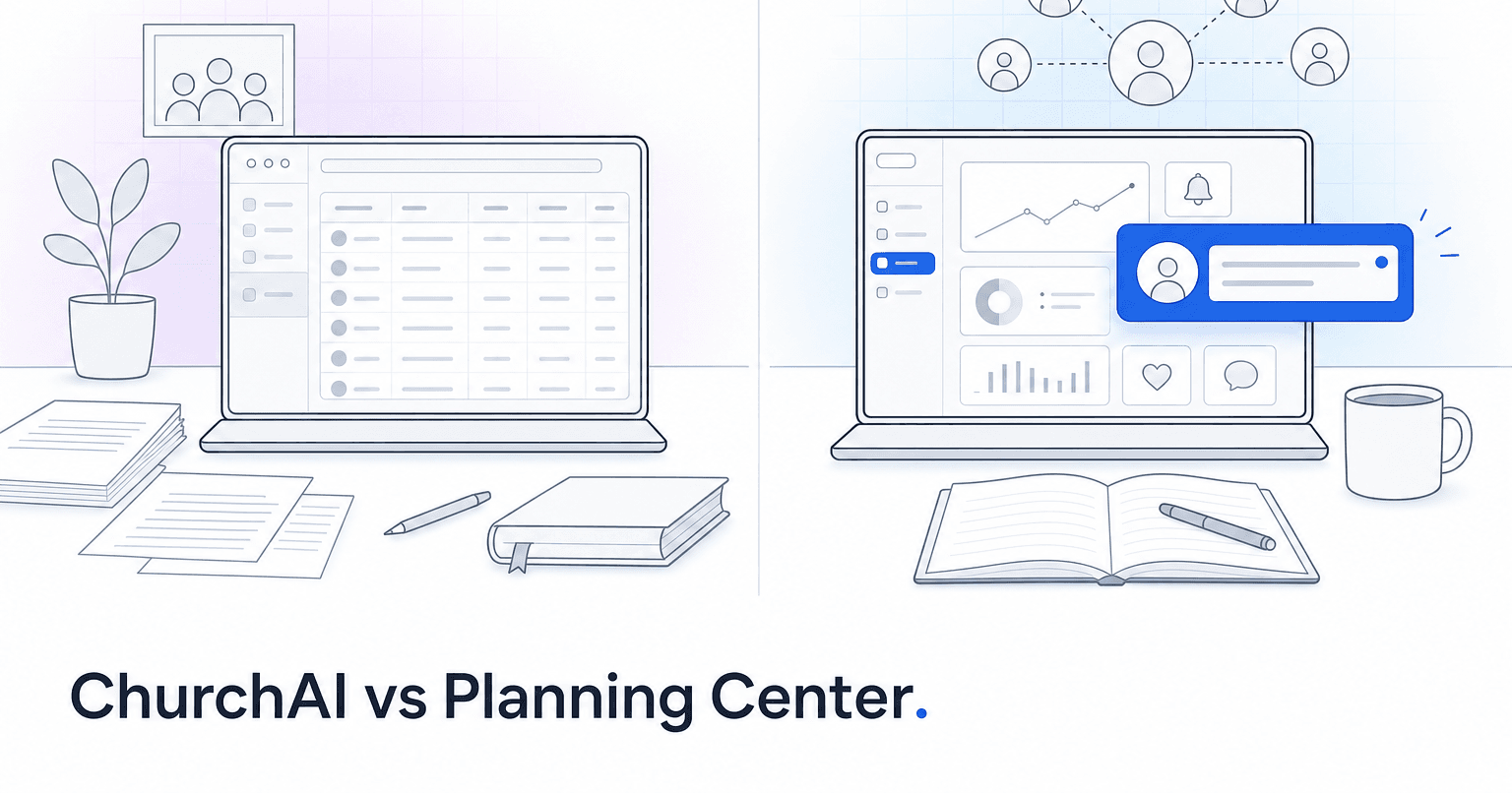
Short answer: Planning Center is a system of record, not a retention system. It stores your data beautifully. ChurchAI reads that data and acts on it, predicting who is disengaging, triggering follow-up before someone quietly drifts out, and surfacing the members most likely to become your next volunteers and donors. If your goal is fewer people slipping away, you do not replace Planning Center. You put ChurchAI on top of it.
That is the honest framing. Now the details.
What each platform is actually built to do
Planning Center is a suite of modules (People, Services, Groups, Giving, Check-Ins, Registrations) that let your staff record attendance, schedule volunteers, plan services, and process gifts. It is excellent at that. It is a well-designed database with workflows attached. The reports it produces are descriptive: who came, who gave, who signed up.
ChurchAI is a prediction and action layer that runs on top of your existing ChMS, including Planning Center, Breeze, and CCB. It ingests the same attendance, giving, and group data you already collect and answers different questions. Who is showing early signs of disengagement? Which second-time visitor looks like a future leader? Which giver just dropped their pattern by 40 percent? Then it acts, sending the text, drafting the email, flagging the pastor.
That is the real distinction. One catalogs the past. The other predicts the near future and closes the loop.
Comparing them on retention outcomes
Detecting disengagement early
- Planning Center: You can pull a report of members who have not checked in for X weeks. Someone on staff has to remember to run it, read it, and decide what to do.
- ChurchAI: Watches attendance rhythm, giving cadence, group participation, and communication response together. When the pattern breaks, it flags the person before the six-week gap becomes a departure.
Follow-up that actually happens
- Planning Center: Workflows can assign a task to a staff member. The follow-up happens if the human does it.
- ChurchAI: Drafts and can send the follow-up automatically, personalized to the member and the reason for the flag. The staff review the message, not build it from scratch.
Identifying new donors and leaders
- Planning Center: Giving reports show who currently gives. Leader identification is manual, based on staff intuition.
- ChurchAI: Surfaces members whose engagement pattern matches your existing donor and leader profiles, so you know who to invite next, not just who already said yes.
Financial reporting and content
- Planning Center: Giving module produces standard statements and reports.
- ChurchAI: Generates board-ready financial narratives, sermon follow-up content, and communication copy in one place, replacing the ChatGPT plus Mailchimp plus Clearstream plus Overflow stack most churches cobble together.
Cost and stack complexity
- Planning Center: Priced per module. Most churches add three or four.
- ChurchAI: One subscription that replaces the separate AI, email, SMS, and financial reporting tools, while sitting alongside your ChMS.
Pick Planning Center if...
You need a solid, affordable system of record and your team has the bandwidth to manually watch reports, build workflows, and follow up on every quiet member yourselves. For a small church with a highly engaged staff and stable attendance, Planning Center alone can be enough.
Pick ChurchAI (on top of Planning Center) if...
Your staff is stretched, your attendance looks healthy but your giving or group numbers are drifting, or you have noticed that visitors are not returning and long-time members are going quiet without anyone catching it in time. If retention is the actual problem, adding a prediction layer solves it in a way that more reports never will. This is the scenario ChurchAI was built for, by pastors who lost people they should not have lost.
The honest bottom line
Planning Center vs ChurchAI is a false either/or. Planning Center is where the data lives. ChurchAI is what turns that data into action before someone leaves. Churches that reduce attrition treat the two as partners: the ChMS records what happened, the AI layer prevents what would have happened next.
If you want to see what the prediction layer surfaces from data you already have, book a walkthrough or reach out through support. Bring last quarter's attendance and giving exports. The gaps show up quickly.
Common questions
- What is ChurchAI?
- ChurchAI is an AI-native church management platform built to help churches retain members, grow giving, and eliminate administrative busywork. Unlike legacy church software that stores data passively, ChurchAI acts as an intelligence layer that connects to your existing tools, analyzes engagement patterns, predicts churn, identifies emerging donors and volunteer leaders, and automates follow-up workflows.
- How is ChurchAI different from Planning Center or other church management software?
- Most church management software like Planning Center, Rock CHMS, or Subsplash are built for administration and reporting. They store data but don't act on it. ChurchAI is built for discipleship and growth. It uses AI to proactively surface insights, predict which members are at risk of leaving, identify first-time and emerging givers, recommend volunteer candidates, and trigger automated follow-up communications. ChurchAI integrates with your existing tools and serves as the command center that turns church data into action.
- Does ChurchAI replace my current church software?
- No. ChurchAI connects directly with your existing church tools including Planning Center, Rock CHMS, Subsplash, Mailchimp, Microsoft Fabric, Power BI, and others. It acts as the intelligence layer on top of your current tech stack, unifying data from scattered systems into one command center without requiring you to switch platforms.
- What problems does ChurchAI solve for churches?
- ChurchAI solves three core problems: (1) Member churn — it identifies disengaged members early through attendance and engagement pattern analysis, then triggers automated follow-up before people fall through the cracks. (2) Missed growth opportunities — it surfaces emerging donors, first-time givers, and potential volunteer leaders that pastors would otherwise miss. (3) Administrative overload — it automates follow-ups, people management, growth tracks, and reporting so church staff can focus on ministry instead of spreadsheets.
- What size churches does ChurchAI work for?
- ChurchAI works for churches of all sizes, from growing congregations to enterprise-level megachurches with multiple campuses and complex tech stacks. The platform scales to handle multi-campus operations with thousands of members, multiple data systems, and sophisticated reporting needs.
- Is ChurchAI an AI chatbot for churches?
- No. ChurchAI is not a chatbot or a simple Q&A tool. It is a full AI-native platform with intelligent agents that analyze church data, score member engagement, predict behavior patterns, automate workflows, and deliver actionable insights. Think of it as an AI-powered Executive Pastor that monitors church health 24/7 and proactively surfaces what needs attention.
- What AI technology does ChurchAI use?
- ChurchAI uses AI-native architecture including large language models, engagement scoring models, predictive analytics for churn and giving patterns, and automated workflow agents. The platform's domain expertise is encoded directly into its AI workflows, prompts, and scoring models, built by founders with over a decade of church leadership experience. This creates a data flywheel where the more churches use ChurchAI, the smarter its predictions and recommendations become.
- How do I get started with ChurchAI?
- Visit churchai.com to request a demo. The ChurchAI team will walk you through the platform, understand your current tech stack and church needs, and show how ChurchAI integrates with your existing tools to deliver immediate value.