· 7 min read
Can Your Church Text Members Without Breaking the Law? A Primer on Opt-In Consent, TCPA, and 10DLC
Yes, and most churches can be compliant in an afternoon. Three things have to be true: you hold documented opt-in consent for every phone number on the list, you honor opt-outs immediately, and the number you send from is registered with the mobile carriers under 10DLC.
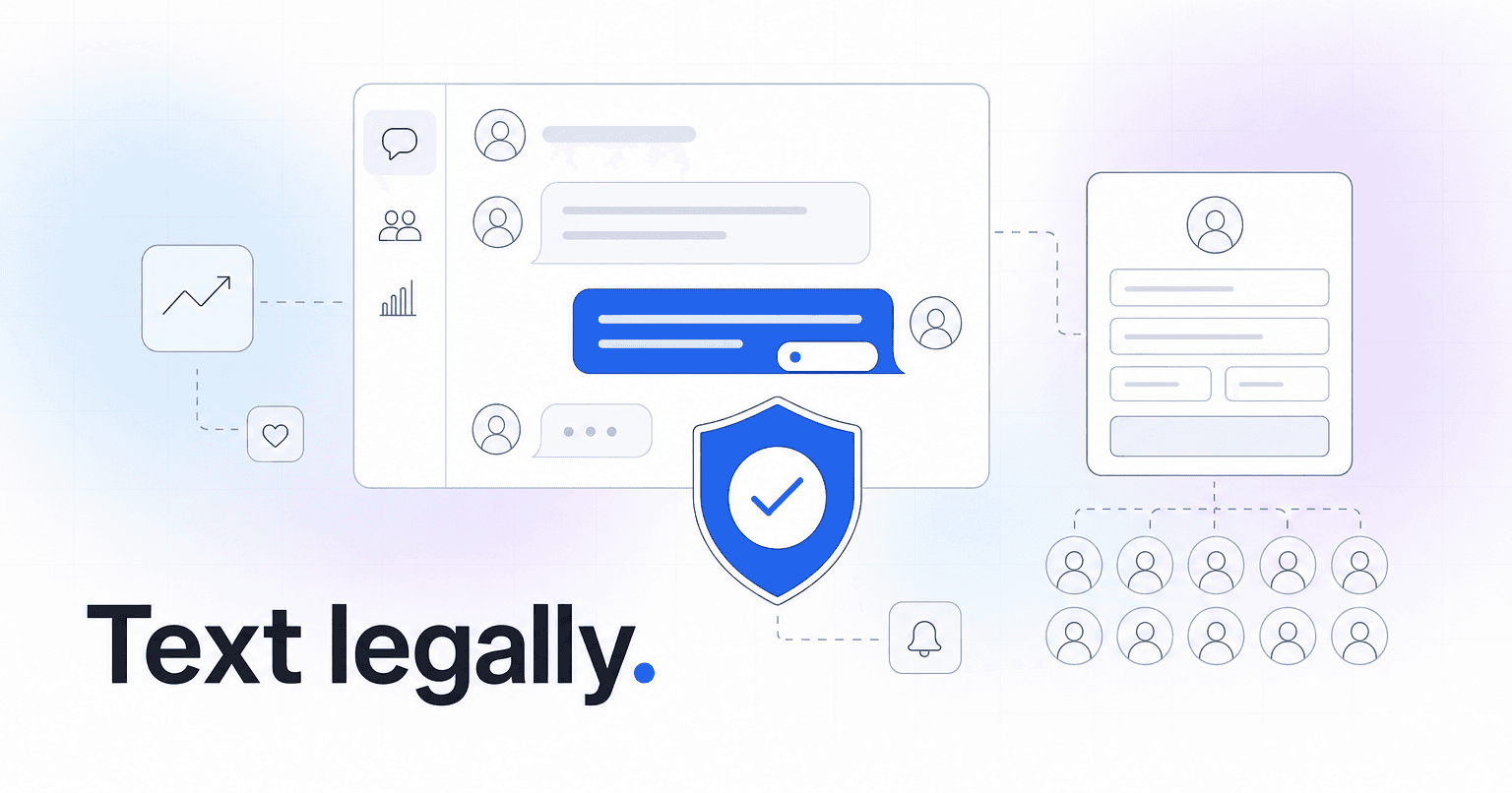
Yes, and most churches can be compliant in an afternoon. Three things have to be true: you hold documented opt-in consent for every phone number on the list, you honor opt-outs immediately, and the number you send from is registered with the mobile carriers under 10DLC. Skip the first and you carry TCPA exposure of 500 to 1,500 dollars per message. Skip the third and your texts get filtered into nothing, delivered to no one, with no bounce notice to tell you.
That second failure is the one that catches churches off guard. Nobody sues you. Attendance updates just quietly stop arriving.
(This is a practical primer, not legal advice. State rules vary, and your denomination's counsel should see your final consent language.)
Does the TCPA apply to churches?
Yes. The Telephone Consumer Protection Act restricts automated calls and texts to mobile numbers, and courts have treated a text message as a call since the Satterfield decision in 2009. Damages are statutory: 500 dollars per message, trebled to 1,500 for willful violations. There is no "we meant well" defense.
There is a nonprofit carve-out, and it is narrower than church staff hope. A 501(c)(3) is exempt from national Do Not Call registry rules for telephone solicitation and from some restrictions on prerecorded voice calls to residential landlines. It is not a free pass to send automated texts to cell phones. Consent still governs.
Consent comes in two tiers:
- Prior express consent covers informational messages. The member knowingly gave you the number for that purpose. Service canceled for ice, small group moved to the Fellowship Hall, your nursery volunteer shift starts at 8:45.
- Prior express written consent covers anything promotional. A signed or electronically signed agreement naming your church, disclosing that messages may be automated, stating rough frequency, noting that consent is not a condition of participation, and mentioning message and data rates. Year-end giving pushes, capital campaign updates, and "invite a friend to Easter" all land here.
My advice: run one standard, the higher one. Churches blur the line constantly. An event reminder that ends with a giving link is a solicitation, whatever you called it in the staff meeting.
What about a pastor texting one person from her own phone?
This is the question that comes up first in every staff meeting, and the answer is reassuring. A human thumb-typing a message to one member from a personal or church-issued phone is person-to-person traffic. No campaign registration, no autodialer question, no 10DLC. Pastoral care over text is fine.
The line gets crossed in two places. First, group messaging apps and "text blast" features inside your ChMS are application-to-person the moment software does the sending, even if a staff member clicked the button. Second, volume and repetition. Forty identical messages fired from one handset in ten minutes looks like spam to carrier filtering, and it will be treated that way regardless of your intent.
Even for genuine one-to-one texting, one rule survives: if someone has asked you to stop, stop. That request follows the person, not the channel.
What counts as opt-in consent, and what does not
Valid opt-in:
- A text-to-join keyword, such as "Text CONNECT to 555-0142," with an automatic confirmation reply.
- A web form or check-in kiosk with an unchecked box and the full disclosure printed next to it.
- A paper connect card with a checkbox and the disclosure on the card, then logged with the date.
Not valid, no matter how obvious it feels:
- A number written on a 2016 directory form.
- A number given verbally to a volunteer coordinator, then pasted into a broadcast list.
- Numbers imported from Planning Center, Breeze, or CCB with no consent field attached. A database is storage, not consent.
- "They are members, they expect to hear from us."
Log the number, the timestamp, the source, and the exact disclosure text the person saw. In a dispute, that record is your defense. Nothing else is. The same discipline applies to the rest of your member data, which we covered in what church member data privacy actually requires.
What is 10DLC, and why do unregistered church texts disappear?
10DLC means 10-digit long code: the ordinary local number your church texts from. A2P means application-to-person, which is any message sent by software rather than a human thumb. Since 2021, US carriers require every A2P sender on a 10DLC to register two layers: a Brand (legal entity name, EIN, address, website) and a Campaign (use case, sample messages, description of how people opt in).
Unregistered A2P traffic gets filtered or blocked outright. The cost of doing it right is trivial: a few dollars one time for brand registration, plus a small monthly campaign fee, lower for a verified charity use case. Toll-free verification works for one-way broadcasts. Short codes run several hundred dollars a month and are overkill for a 600-person congregation.
Why church 10DLC registrations get rejected
Five reasons account for nearly all of them.
- Legal name or EIN mismatch. Use the exact entity name on your IRS determination letter. "Grace Church" fails when the filing says "Grace Community Church of Springfield, Inc."
- Opt-in flow the reviewer cannot see. They want a public URL or a screenshot of the actual form. Publish the signup page on your site before you submit.
- Privacy policy missing the mobile clause. Carriers look for explicit language stating that mobile opt-in data and consent are not sold or shared with third parties for marketing. Add that sentence verbatim.
- Sample messages without brand or opt-out. Every sample must name the church and carry "Reply STOP to opt out" on the first message of a conversation.
- Wrong use case. Register the mix you actually send. If you send both service reminders and giving appeals, say so, with a real sample of each.
The rules that bite after you are registered
Quiet hours. 8:00 a.m. to 9:00 p.m. in the recipient's local time zone. The 11 p.m. urgent prayer chain blast is a violation. Some states are tighter.
Opt-outs. Carriers handle STOP and HELP automatically on a registered 10DLC, but your platform has to push that suppression back into your ChMS, or a well-meaning staff member re-adds the person next month. The FCC requires revocation to be honored within 10 business days. Do it instantly. And any reasonable phrasing counts, including "please stop" typed as a reply to your youth pastor.
Reassigned numbers. Millions of US mobile numbers change hands every year, and the consent a member gave you in 2021 does not transfer to whoever holds that number now. Watch for hard bounces and undeliverable codes, and scrub numbers that have gone silent across several sends rather than retrying them forever. A church list that has never been cleaned is a list that is texting strangers.
State mini-TCPA laws. Florida, Oklahoma, and Washington have their own statutes with private rights of action and tighter windows. If you have members who winter in Florida, follow the strictest rule for everyone.
Minors. Youth ministry texting needs documented parental consent and a separate list. Do not fold student numbers into the all-church broadcast.
A short setup checklist
- Publish a signup page with compliant disclosure language and link it in your footer.
- Add the mobile-data clause to your privacy policy.
- Register your Brand with the exact IRS legal name and EIN.
- Register one Campaign per real use case, with named samples and STOP language.
- Add a consent field to your member records and backfill it. Anyone without documented consent gets a one-time invitation through email, not a text.
- Wire opt-outs so suppression syncs automatically across every tool that can send.
Step six is where churches running four disconnected tools lose the thread. ChurchAI keeps consent status, opt-outs, and automated follow-up workflows on one member record, so a person who texts STOP on Sunday is not receiving a volunteer reminder on Wednesday. Compliance holds up when it is a property of the system, not a habit somebody has to remember.
Common questions
- What is ChurchAI?
- ChurchAI is an AI-native church management platform built to help churches retain members, grow giving, and eliminate administrative busywork. Unlike legacy church software that stores data passively, ChurchAI acts as an intelligence layer that connects to your existing tools, analyzes engagement patterns, predicts churn, identifies emerging donors and volunteer leaders, and automates follow-up workflows.
- How is ChurchAI different from Planning Center or other church management software?
- Most church management software like Planning Center, Rock CHMS, or Subsplash are built for administration and reporting. They store data but don't act on it. ChurchAI is built for discipleship and growth. It uses AI to proactively surface insights, predict which members are at risk of leaving, identify first-time and emerging givers, recommend volunteer candidates, and trigger automated follow-up communications. ChurchAI integrates with your existing tools and serves as the command center that turns church data into action.
- Does ChurchAI replace my current church software?
- No. ChurchAI connects directly with your existing church tools including Planning Center, Rock CHMS, Subsplash, Mailchimp, Microsoft Fabric, Power BI, and others. It acts as the intelligence layer on top of your current tech stack, unifying data from scattered systems into one command center without requiring you to switch platforms.
- What problems does ChurchAI solve for churches?
- ChurchAI solves three core problems: (1) Member churn — it identifies disengaged members early through attendance and engagement pattern analysis, then triggers automated follow-up before people fall through the cracks. (2) Missed growth opportunities — it surfaces emerging donors, first-time givers, and potential volunteer leaders that pastors would otherwise miss. (3) Administrative overload — it automates follow-ups, people management, growth tracks, and reporting so church staff can focus on ministry instead of spreadsheets.
- What size churches does ChurchAI work for?
- ChurchAI works for churches of all sizes, from growing congregations to enterprise-level megachurches with multiple campuses and complex tech stacks. The platform scales to handle multi-campus operations with thousands of members, multiple data systems, and sophisticated reporting needs.
- Is ChurchAI an AI chatbot for churches?
- No. ChurchAI is not a chatbot or a simple Q&A tool. It is a full AI-native platform with intelligent agents that analyze church data, score member engagement, predict behavior patterns, automate workflows, and deliver actionable insights. Think of it as an AI-powered Executive Pastor that monitors church health 24/7 and proactively surfaces what needs attention.
- What AI technology does ChurchAI use?
- ChurchAI uses AI-native architecture including large language models, engagement scoring models, predictive analytics for churn and giving patterns, and automated workflow agents. The platform's domain expertise is encoded directly into its AI workflows, prompts, and scoring models, built by founders with over a decade of church leadership experience. This creates a data flywheel where the more churches use ChurchAI, the smarter its predictions and recommendations become.
- How do I get started with ChurchAI?
- Visit churchai.com to request a demo. The ChurchAI team will walk you through the platform, understand your current tech stack and church needs, and show how ChurchAI integrates with your existing tools to deliver immediate value.