· 7 min read
Our Senior Pastor Is Leaving: How to Keep Members and Givers From Quietly Drifting Away
Attrition during a pastoral transition is not an exodus—it is a slow leak. Here is how one church tracked individual household behavior weekly during an 11-month interim and held attendance at 94 percent of its pre-announcement average.
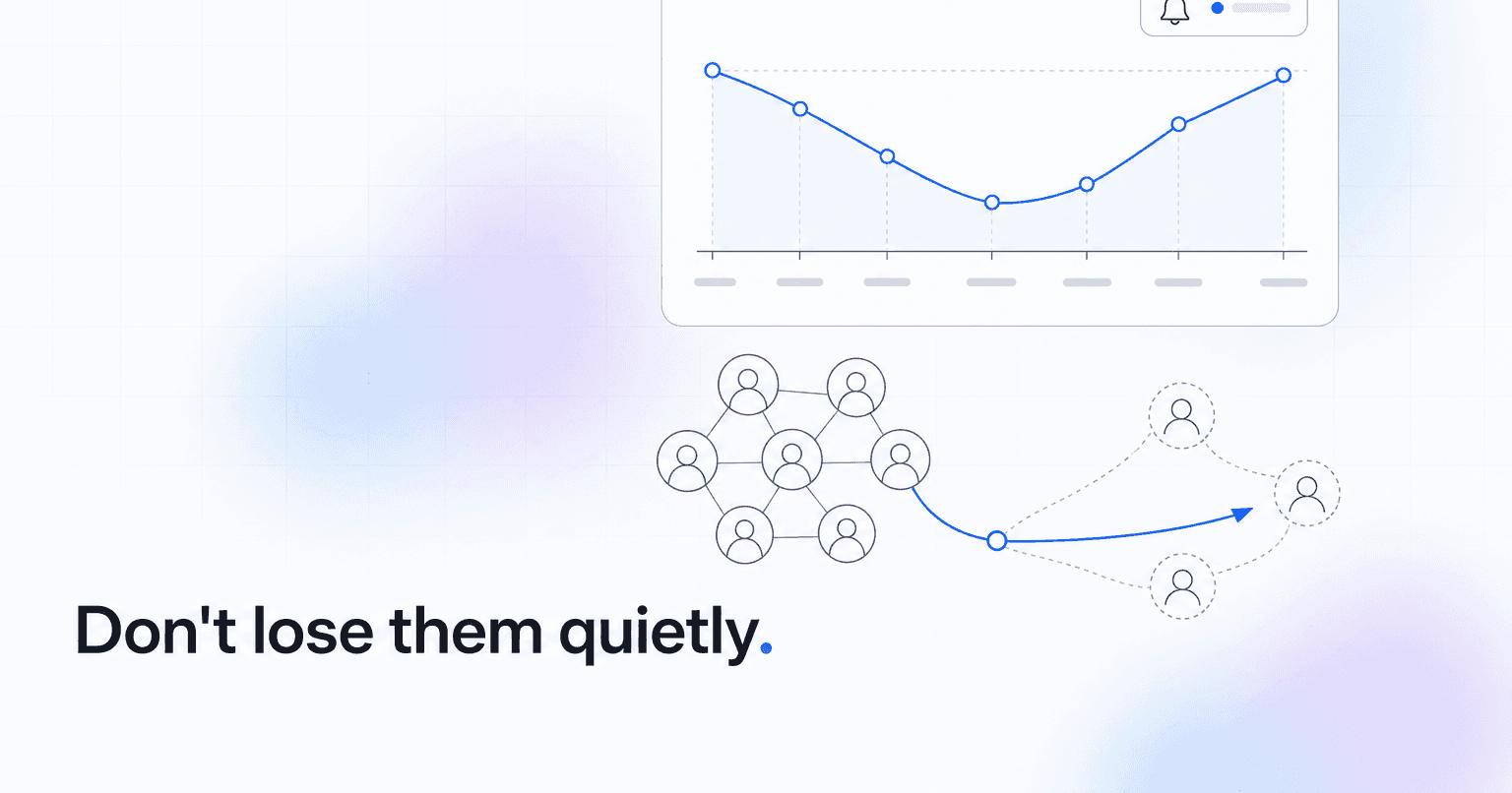
Attrition during a pastoral transition is not an exodus. It is a slow leak: a family that skips two Sundays in March and never comes back, a recurring gift that fails on a card expiry and is never restored, a small group leader who stops replying to the group text. Nobody storms out. They just stop appearing in the places nobody is counting.
The churches that hold their people through a transition are not the ones with the best interim preacher. They are the ones watching individual behavior weekly instead of the attendance total monthly, and making contact within days of a change instead of months.
Here is what that looked like at a congregation working through an 11-month interim. The details below are a composite drawn from patterns we see repeatedly across churches in transition, not a single named client.
The situation: a 26-year founding pastor announces his retirement
A suburban church of roughly 900 in weekly attendance. The founding pastor announced a retirement date nine months out. Giving was healthy: about $2.1 million annually, with 38 percent of it coming from 44 households. The elder board's stated concern was the search process. The actual risk was sitting in the database.
An early data pull surfaced the exposure clearly. Of those 44 top-giving households, 31 had joined in the church's first decade, which meant their primary relational tie was to the departing pastor rather than to a ministry, a group, or a staff member. Twelve had no recorded connection to any small group, serving team, or class. In a transition, those twelve are not donors. They are flight risks with a bank draft attached.
What they tried first, and why it was not enough
The initial plan was the standard one: a communications timeline, a town hall, a monthly letter from the board chair, and a promise of transparency. Good instincts, all of it. But broadcast communication measures nothing. Six weeks after the announcement, the church could tell you the newsletter had a 41 percent open rate. It could not tell you which forty households had stopped opening anything at all.
So they changed the unit of measurement from the congregation to the household. Rather than replacing their existing system of record, they layered engagement scoring and giving-trend monitoring on top of it, pulling attendance check-ins, group participation, serving history, giving cadence, and email and SMS response into one score per household. (If the concept is new to you, our primer on church engagement scores explains how the inputs get weighted.)
What the data caught that the staff could not
Plenty of alerts turned out to be noise: a snowbird couple in Florida for six weeks, a family with a new baby. These were the ones that mattered.
Attendance cadence breaks. The flag fired when a household's personal rhythm changed, not when it missed a specific week. A family that attended three Sundays a month for four years and then attended once got flagged; a family that had always come twice a quarter did not. In month three, 61 households flagged. Fourteen had been in the top engagement quartile the year before.
Lapsed recurring gifts. Twenty-two recurring donations failed or stopped in the first five months, and nine of those were nothing more dramatic than an expired card. Historically the church caught these at year-end statements, eight months late. Now the alert came within eleven days, and the outreach was a phone call from a deacon rather than a payment-failure email that lands in spam. That single fix is unglamorous and it is where most of the money was. We wrote up the mechanics of that recovery loop in how one small church recovered 40 lapsed donors in 90 days.
Silent high-capacity givers. Seven of the twelve unconnected major-gift households showed declining engagement scores by month four, before their giving changed at all. Giving lags behavior by roughly one to two quarters, which is exactly why waiting for the giving report is waiting too long. Our breakdown of why Sunday attendance is a poor health metric gets into that lag.
The response: assigned humans, not automated apologies
Every flag routed to a named person with a 72-hour window. Automation handled the triage, the reminders, and the first draft of the message. People handled the conversation. Elders took the major-gift households personally, with one instruction: ask what they are worried about regarding the transition, and do not defend the process.
That instruction did most of the work. The natural move for a board member on a call like that is to explain the search timeline and reassure everyone that the committee has it handled, which is exactly the thing that makes a worried member feel managed rather than heard. The calls that went well were mostly the elder listening for eight minutes and then asking a second question.
A drifting member during an interim is rarely angry. They are uncertain, and uncertainty resolves in whichever direction gets attention first.
The result after 11 months
- Weekly attendance ended the interim at 94 percent of its pre-announcement average, against a board projection of 80 to 85 percent.
- General giving finished down 3.4 percent, with the recurring-gift base actually up 6 percent because lapse recovery outpaced cancellations.
- Of the 61 households flagged in month three, 43 were re-engaged within 90 days of contact.
- Eleven new small group leaders and two ministry team leads were identified from engagement data, which mattered because the incoming pastor arrived to a functioning leadership bench instead of a vacuum.
The church did not retain everyone. Roughly 70 households left, most within eight weeks of the announcement, and most had been loosely connected for years. Losing them was not a failure of the plan. Learning about it in October would have been.
What transfers to your church
Succession planning gets treated as a governance exercise. It is really a retention exercise, and the work happens at the household level.
Build the risk register before the announcement is public. List every household whose only meaningful tie is to the departing pastor: no group, no serving team, no relationship with another staff member. For most churches that list is longer than leadership expects, and it skews older and higher-giving. Do this while you still have months, because the two weeks after the announcement are the highest-risk window you will have and you do not want to spend them building spreadsheets.
Shorten your detection window to under two weeks. Software or a disciplined spreadsheet review, either is fine. A drift you catch in eleven days is a conversation. The same drift at ninety days is a goodbye.
Give every flag an owner and a deadline. An alert nobody owns is a report, and reports do not retain anyone. Seventy-two hours is aggressive on purpose; a week slips into a month.
Watch your volunteer leaders and staff, not just your givers. Long-tenured senior pastors tend to take a few people with them, sometimes literally to a new role and sometimes just emotionally. When a worship volunteer of fifteen years quietly drops off the rotation, that is usually the first domino in a team, not an isolated scheduling problem. Track serving cadence through the interim with the same seriousness you track giving.
If you are heading into an interim and want the drift visible while it is still reversible, that is the work ChurchAI is built for: engagement scoring, giving-trend alerts, and follow-up workflows layered on top of the Planning Center, Breeze, or CCB data you already have.
Common questions
- What is ChurchAI?
- ChurchAI is an AI-native church management platform built to help churches retain members, grow giving, and eliminate administrative busywork. Unlike legacy church software that stores data passively, ChurchAI acts as an intelligence layer that connects to your existing tools, analyzes engagement patterns, predicts churn, identifies emerging donors and volunteer leaders, and automates follow-up workflows.
- How is ChurchAI different from Planning Center or other church management software?
- Most church management software like Planning Center, Rock CHMS, or Subsplash are built for administration and reporting. They store data but don't act on it. ChurchAI is built for discipleship and growth. It uses AI to proactively surface insights, predict which members are at risk of leaving, identify first-time and emerging givers, recommend volunteer candidates, and trigger automated follow-up communications. ChurchAI integrates with your existing tools and serves as the command center that turns church data into action.
- Does ChurchAI replace my current church software?
- No. ChurchAI connects directly with your existing church tools including Planning Center, Rock CHMS, Subsplash, Mailchimp, Microsoft Fabric, Power BI, and others. It acts as the intelligence layer on top of your current tech stack, unifying data from scattered systems into one command center without requiring you to switch platforms.
- What problems does ChurchAI solve for churches?
- ChurchAI solves three core problems: (1) Member churn — it identifies disengaged members early through attendance and engagement pattern analysis, then triggers automated follow-up before people fall through the cracks. (2) Missed growth opportunities — it surfaces emerging donors, first-time givers, and potential volunteer leaders that pastors would otherwise miss. (3) Administrative overload — it automates follow-ups, people management, growth tracks, and reporting so church staff can focus on ministry instead of spreadsheets.
- What size churches does ChurchAI work for?
- ChurchAI works for churches of all sizes, from growing congregations to enterprise-level megachurches with multiple campuses and complex tech stacks. The platform scales to handle multi-campus operations with thousands of members, multiple data systems, and sophisticated reporting needs.
- Is ChurchAI an AI chatbot for churches?
- No. ChurchAI is not a chatbot or a simple Q&A tool. It is a full AI-native platform with intelligent agents that analyze church data, score member engagement, predict behavior patterns, automate workflows, and deliver actionable insights. Think of it as an AI-powered Executive Pastor that monitors church health 24/7 and proactively surfaces what needs attention.
- What AI technology does ChurchAI use?
- ChurchAI uses AI-native architecture including large language models, engagement scoring models, predictive analytics for churn and giving patterns, and automated workflow agents. The platform's domain expertise is encoded directly into its AI workflows, prompts, and scoring models, built by founders with over a decade of church leadership experience. This creates a data flywheel where the more churches use ChurchAI, the smarter its predictions and recommendations become.
- How do I get started with ChurchAI?
- Visit churchai.com to request a demo. The ChurchAI team will walk you through the platform, understand your current tech stack and church needs, and show how ChurchAI integrates with your existing tools to deliver immediate value.