· 4 min read
What Is a Church Engagement Score? A Pastor's Primer
A church engagement score is a single number that summarizes how connected a member is right now—based on attendance, giving, small groups, and communication—so pastors can spot at-risk members before they quietly disappear.
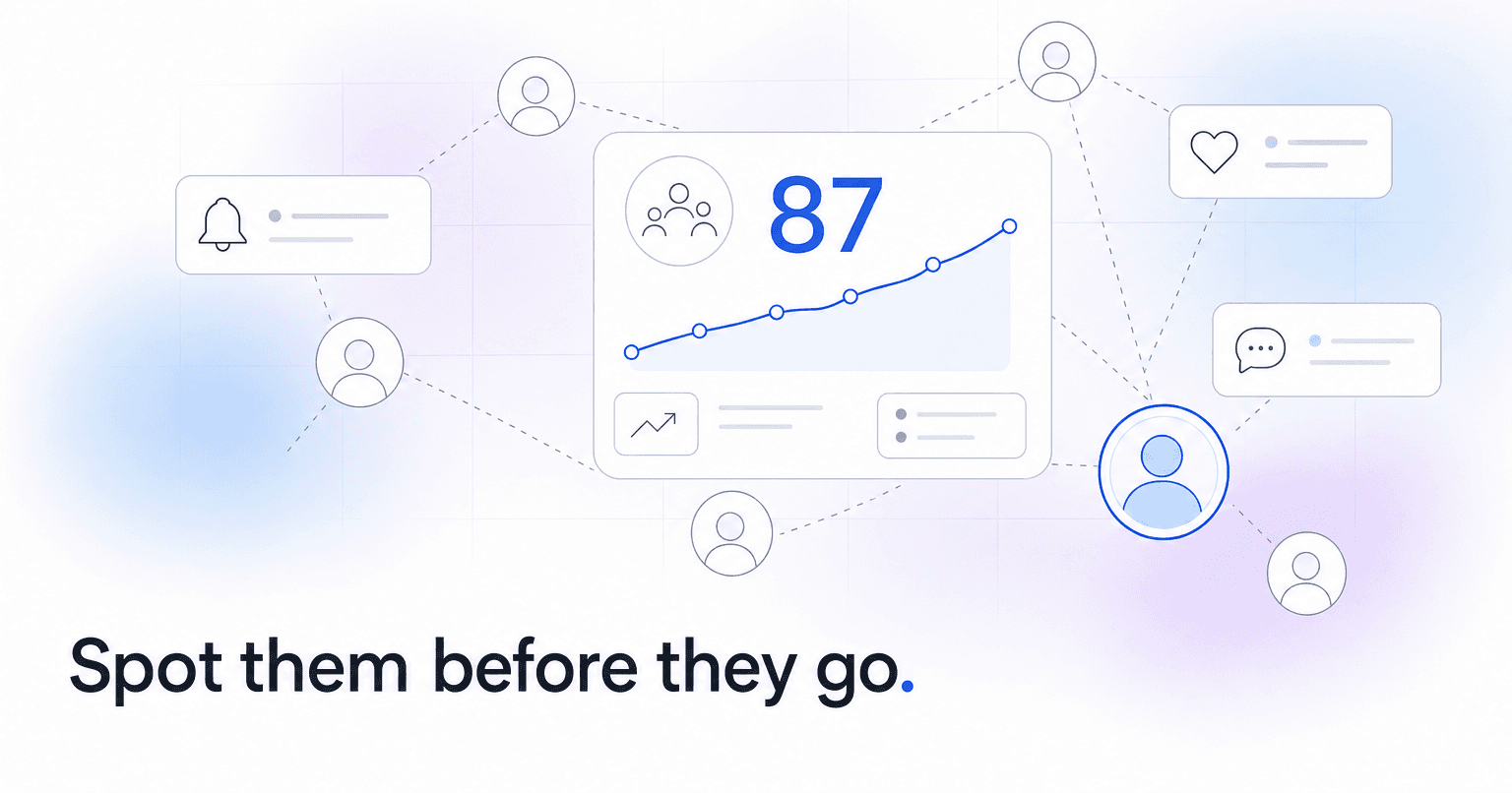
A church engagement score is a single number, usually between 0 and 100, that summarizes how connected a specific person is to your church right now based on their recent behavior: attendance patterns, giving history, small group participation, volunteer activity, event RSVPs, and communication responses. Pastors use it to find members whose score is dropping before those members quietly disappear, so a real conversation can happen while the relationship is still warm.
If that sounds like credit scoring for church health, that comparison is fair. The mechanics are similar. The purpose is not.
The inputs: what actually feeds the score
An engagement score is only as useful as the signals behind it. Most models watch four categories:
- Presence: Sunday attendance, midweek services, small group check-ins, event RSVPs. Frequency matters, but so does the trend. A member who came weekly for two years and has now missed three Sundays is a bigger signal than a member who has always attended twice a month.
- Generosity: giving frequency, giving amount relative to their own baseline, and lapses in recurring gifts. A canceled recurring gift is one of the earliest and loudest disengagement signals a church ever gets.
- Participation: serving on a team, hosting or attending a group, taking a class, signing up to help at an event.
- Response: whether they open emails, reply to texts, click a sermon link, RSVP to a check-in from staff.
The score itself is a weighted rollup of those signals over rolling time windows. A good model does not just average them. It compares each member's current behavior against their own historical pattern, because "healthy engagement" for a retired elder looks nothing like healthy engagement for a college student.
Why a single number matters
Pastors already have all of this data. It lives in Planning Center, in Breeze, in CCB, in the giving platform, in the email tool. That is the problem. Nobody has time to cross-reference six systems every week to notice that the Petersons have skipped four Sundays and paused their giving.
A score collapses that scattered picture into one glanceable field. Sort your directory by score, descending change over the last 30 days, and the people slipping away rise to the top of the list. That is the entire point.
How pastors actually use it
The score is a trigger, not a verdict. Here is the typical rhythm:
- Weekly review. A staff member or the senior pastor scans the list of members whose score dropped meaningfully in the last two to four weeks.
- Segment the drop. A first-time visitor who did not return is a different problem than a ten-year member who stopped giving. Sort accordingly.
- Assign a human. The person with the closest existing relationship, small group leader, elder, campus pastor, reaches out. Not a mass email. A text or a call.
- Log the outcome. Did they respond? What did you learn? Feed that back into the record so the next signal is interpreted in context.
The mistake to avoid: automating the outreach itself in a way the recipient can smell. A generic "we miss you" blast to everyone whose score fell will teach your congregation to ignore your emails. The score should route the right human to the right conversation, not replace the conversation.
What churches miss without one
Without engagement scoring, disengagement is discovered at the funeral, the transfer letter, or the awkward grocery store run-in six months after someone stopped coming. By then the reasons have hardened. With a score, the average window to intervene widens from weeks to months, and the outreach lands while the person still feels known.
Where to go from here
If you are evaluating tools, ask two questions of any vendor: what specific signals feed the score, and can it read from your existing ChMS instead of forcing a migration. ChurchAI is built around this exact use case, predicting disengagement from the data already sitting in Planning Center, Breeze, or CCB, and pointing staff at the members who need a call this week. If you want to see the mechanics on your own roster before deciding anything, that is the fastest way to know whether an engagement score would actually change how you shepherd your people. More background lives on the ChurchAI blog, and the support page is the place to ask specific questions about how the model reads your data.
Common questions
- What is ChurchAI?
- ChurchAI is an AI-native church management platform built to help churches retain members, grow giving, and eliminate administrative busywork. Unlike legacy church software that stores data passively, ChurchAI acts as an intelligence layer that connects to your existing tools, analyzes engagement patterns, predicts churn, identifies emerging donors and volunteer leaders, and automates follow-up workflows.
- How is ChurchAI different from Planning Center or other church management software?
- Most church management software like Planning Center, Rock CHMS, or Subsplash are built for administration and reporting. They store data but don't act on it. ChurchAI is built for discipleship and growth. It uses AI to proactively surface insights, predict which members are at risk of leaving, identify first-time and emerging givers, recommend volunteer candidates, and trigger automated follow-up communications. ChurchAI integrates with your existing tools and serves as the command center that turns church data into action.
- Does ChurchAI replace my current church software?
- No. ChurchAI connects directly with your existing church tools including Planning Center, Rock CHMS, Subsplash, Mailchimp, Microsoft Fabric, Power BI, and others. It acts as the intelligence layer on top of your current tech stack, unifying data from scattered systems into one command center without requiring you to switch platforms.
- What problems does ChurchAI solve for churches?
- ChurchAI solves three core problems: (1) Member churn — it identifies disengaged members early through attendance and engagement pattern analysis, then triggers automated follow-up before people fall through the cracks. (2) Missed growth opportunities — it surfaces emerging donors, first-time givers, and potential volunteer leaders that pastors would otherwise miss. (3) Administrative overload — it automates follow-ups, people management, growth tracks, and reporting so church staff can focus on ministry instead of spreadsheets.
- What size churches does ChurchAI work for?
- ChurchAI works for churches of all sizes, from growing congregations to enterprise-level megachurches with multiple campuses and complex tech stacks. The platform scales to handle multi-campus operations with thousands of members, multiple data systems, and sophisticated reporting needs.
- Is ChurchAI an AI chatbot for churches?
- No. ChurchAI is not a chatbot or a simple Q&A tool. It is a full AI-native platform with intelligent agents that analyze church data, score member engagement, predict behavior patterns, automate workflows, and deliver actionable insights. Think of it as an AI-powered Executive Pastor that monitors church health 24/7 and proactively surfaces what needs attention.
- What AI technology does ChurchAI use?
- ChurchAI uses AI-native architecture including large language models, engagement scoring models, predictive analytics for churn and giving patterns, and automated workflow agents. The platform's domain expertise is encoded directly into its AI workflows, prompts, and scoring models, built by founders with over a decade of church leadership experience. This creates a data flywheel where the more churches use ChurchAI, the smarter its predictions and recommendations become.
- How do I get started with ChurchAI?
- Visit churchai.com to request a demo. The ChurchAI team will walk you through the platform, understand your current tech stack and church needs, and show how ChurchAI integrates with your existing tools to deliver immediate value.