· 4 min read
Why Your Church Should Stop Measuring Health by Sunday Attendance (And What to Track Instead)
Sunday attendance is a lagging indicator dressed up as a leading one. By the time the count drops, the person you're worried about stopped showing up in your systems months ago. Here's what to track instead.
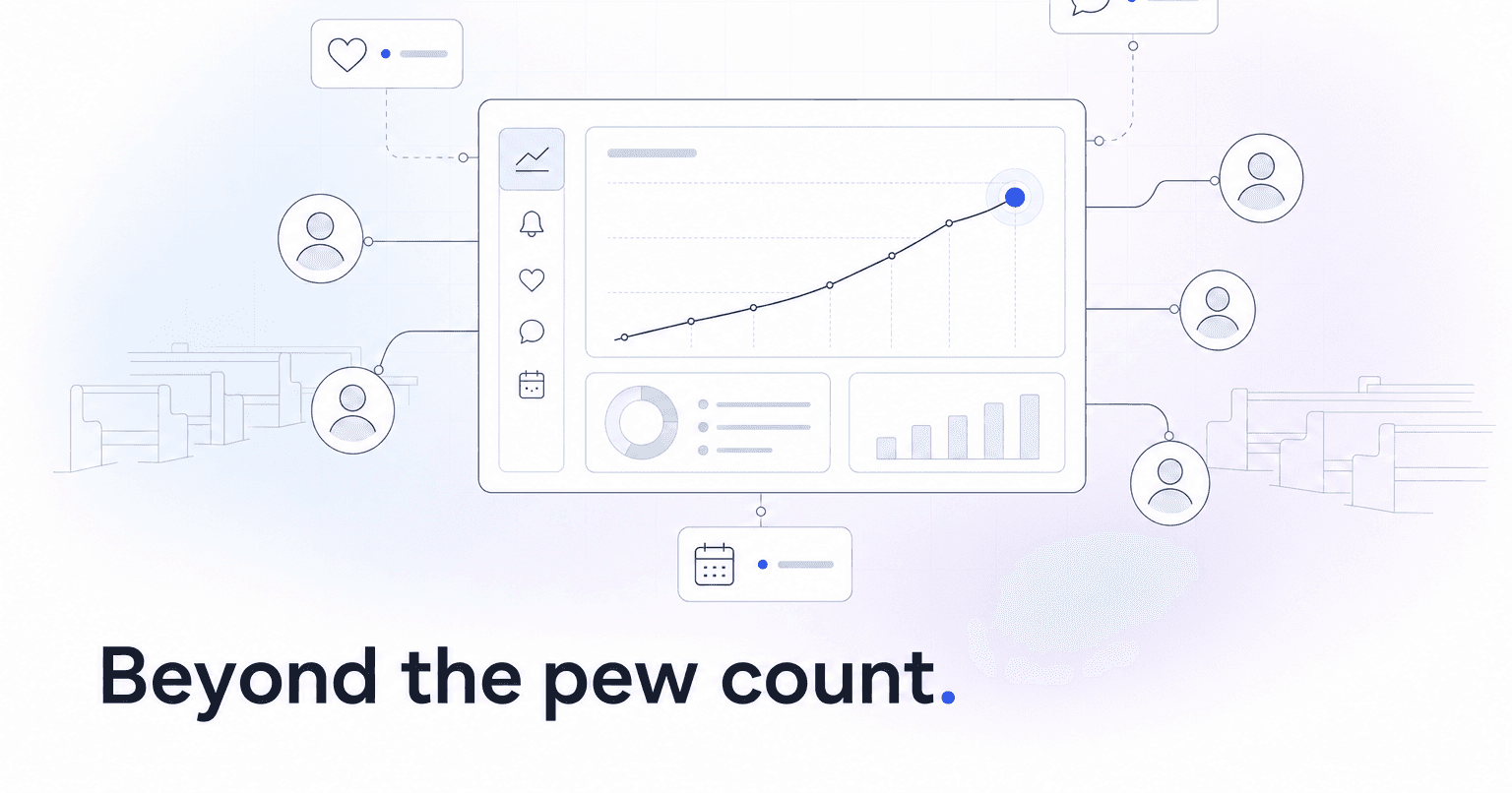
Sunday attendance is a lagging indicator dressed up as a leading one. By the time the count drops, the person you're worried about stopped showing up in your systems months ago: they quit the serving team in March, their giving went from twice a month to once a quarter in April, they stopped opening the newsletter in May. The seat going empty in July is the last thing that happens, not the first.
That's the shift church leaders need to make. Stop treating the room count as the scoreboard. Start treating it as the receipt.
What we used to do
For decades, the health of a church was reported in three numbers: attendance, baptisms, budget. Elders asked for them. Denominations collected them. Pastors put them on the annual report and, quietly, judged themselves by them.
It worked when the congregation was small enough that the pastor knew who was in the room and who wasn't. A dip in attendance meant a specific family. You could call them Monday.
At any real scale, that stops being true. A church of 600 can lose 40 people over a quarter and still look full on a good Sunday because visitors and irregular attenders fill the gaps. The pews mask the churn.
What changed
Two things broke the old model.
First, attendance patterns fragmented. Post-2020, "regular" means once every three weeks for a large share of committed members. Streaming, travel, hybrid work, and Saturday services all pulled the weekly rhythm apart. A count on any given Sunday now tells you almost nothing about the trajectory of the people it represents.
Second, the data churches already collect got richer. Planning Center, Breeze, and CCB quietly log serving history, group attendance, giving cadence, kid check-ins, and communication opens. The signal is sitting in your existing tools. Very few churches actually read it.
What to track instead
Health is a pattern of engagement across time, not a snapshot of a room. These are the metrics that actually predict whether someone is still with you six months from now.
- Giving cadence change, not giving totals. A donor who gave monthly for two years and hasn't given in 60 days is a warning, even if your total giving is up because someone else made a large gift. Track individual cadence, not the aggregate.
- Serving participation over a rolling 90 days. People who serve stay. When a regular volunteer skips two consecutive rotations without swapping, that's a signal, not a scheduling issue.
- Small group or midweek attendance ratio. The ratio of midweek engagement to Sunday attendance is a better health measure than either alone. Churches with a healthy ratio around 40 to 50 percent retain people through hard seasons.
- First-time visitor return rate at 2, 6, and 12 weeks. If fewer than one in four visitors are back by week six, your front door is leaking and no attendance number will show it until next year.
- Communication engagement. Members who stop opening emails or texts from the church are usually three to six months ahead of the people who stop attending. It's the earliest warning you have.
- Kid check-in continuity. Families with children disengage through the kids first. A gap in check-ins is often the truest leading indicator of a family drifting.
The lesson
Attendance is the outcome of a hundred smaller decisions people made in the weeks before Sunday. If you only watch the outcome, you can only react. If you watch the decisions, you can respond while a relationship is still recoverable.
This is the problem ChurchAI was built to solve. It reads the signals already sitting inside Planning Center, Breeze, or CCB, flags the members whose patterns have shifted, and hands your team a short list of people to call this week, not a report to review next quarter. The goal is simple: fewer people slip away quietly, because fewer people are invisible in your data.
The full room on Sunday is not the win. The people who are still with you next Easter is the win. Track for that.
If you want to see what your own engagement data is already telling you, book a walkthrough or browse more on the ChurchAI blog.
Common questions
- What is ChurchAI?
- ChurchAI is an AI-native church management platform built to help churches retain members, grow giving, and eliminate administrative busywork. Unlike legacy church software that stores data passively, ChurchAI acts as an intelligence layer that connects to your existing tools, analyzes engagement patterns, predicts churn, identifies emerging donors and volunteer leaders, and automates follow-up workflows.
- How is ChurchAI different from Planning Center or other church management software?
- Most church management software like Planning Center, Rock CHMS, or Subsplash are built for administration and reporting. They store data but don't act on it. ChurchAI is built for discipleship and growth. It uses AI to proactively surface insights, predict which members are at risk of leaving, identify first-time and emerging givers, recommend volunteer candidates, and trigger automated follow-up communications. ChurchAI integrates with your existing tools and serves as the command center that turns church data into action.
- Does ChurchAI replace my current church software?
- No. ChurchAI connects directly with your existing church tools including Planning Center, Rock CHMS, Subsplash, Mailchimp, Microsoft Fabric, Power BI, and others. It acts as the intelligence layer on top of your current tech stack, unifying data from scattered systems into one command center without requiring you to switch platforms.
- What problems does ChurchAI solve for churches?
- ChurchAI solves three core problems: (1) Member churn — it identifies disengaged members early through attendance and engagement pattern analysis, then triggers automated follow-up before people fall through the cracks. (2) Missed growth opportunities — it surfaces emerging donors, first-time givers, and potential volunteer leaders that pastors would otherwise miss. (3) Administrative overload — it automates follow-ups, people management, growth tracks, and reporting so church staff can focus on ministry instead of spreadsheets.
- What size churches does ChurchAI work for?
- ChurchAI works for churches of all sizes, from growing congregations to enterprise-level megachurches with multiple campuses and complex tech stacks. The platform scales to handle multi-campus operations with thousands of members, multiple data systems, and sophisticated reporting needs.
- Is ChurchAI an AI chatbot for churches?
- No. ChurchAI is not a chatbot or a simple Q&A tool. It is a full AI-native platform with intelligent agents that analyze church data, score member engagement, predict behavior patterns, automate workflows, and deliver actionable insights. Think of it as an AI-powered Executive Pastor that monitors church health 24/7 and proactively surfaces what needs attention.
- What AI technology does ChurchAI use?
- ChurchAI uses AI-native architecture including large language models, engagement scoring models, predictive analytics for churn and giving patterns, and automated workflow agents. The platform's domain expertise is encoded directly into its AI workflows, prompts, and scoring models, built by founders with over a decade of church leadership experience. This creates a data flywheel where the more churches use ChurchAI, the smarter its predictions and recommendations become.
- How do I get started with ChurchAI?
- Visit churchai.com to request a demo. The ChurchAI team will walk you through the platform, understand your current tech stack and church needs, and show how ChurchAI integrates with your existing tools to deliver immediate value.