· 5 min read
What Should I Look For in a Church Engagement Platform? A Category-by-Category Comparison
"Engagement platform" is not really a product category—it is four different categories wearing the same label. Here is how to tell them apart and pick the right one for your church.
Look for six things. A unified member record that combines attendance, giving, serving, and response history. A signal that tells you who is drifting before they stop showing up. Automation that acts on that signal without a staff member remembering to. Clean integration with the ChMS you already run. Role-based access controls over sensitive data. And a clear answer to what happens to your records if you leave.
Most products marketed as "engagement platforms" only do two or three of those well, because they grew out of a different problem.
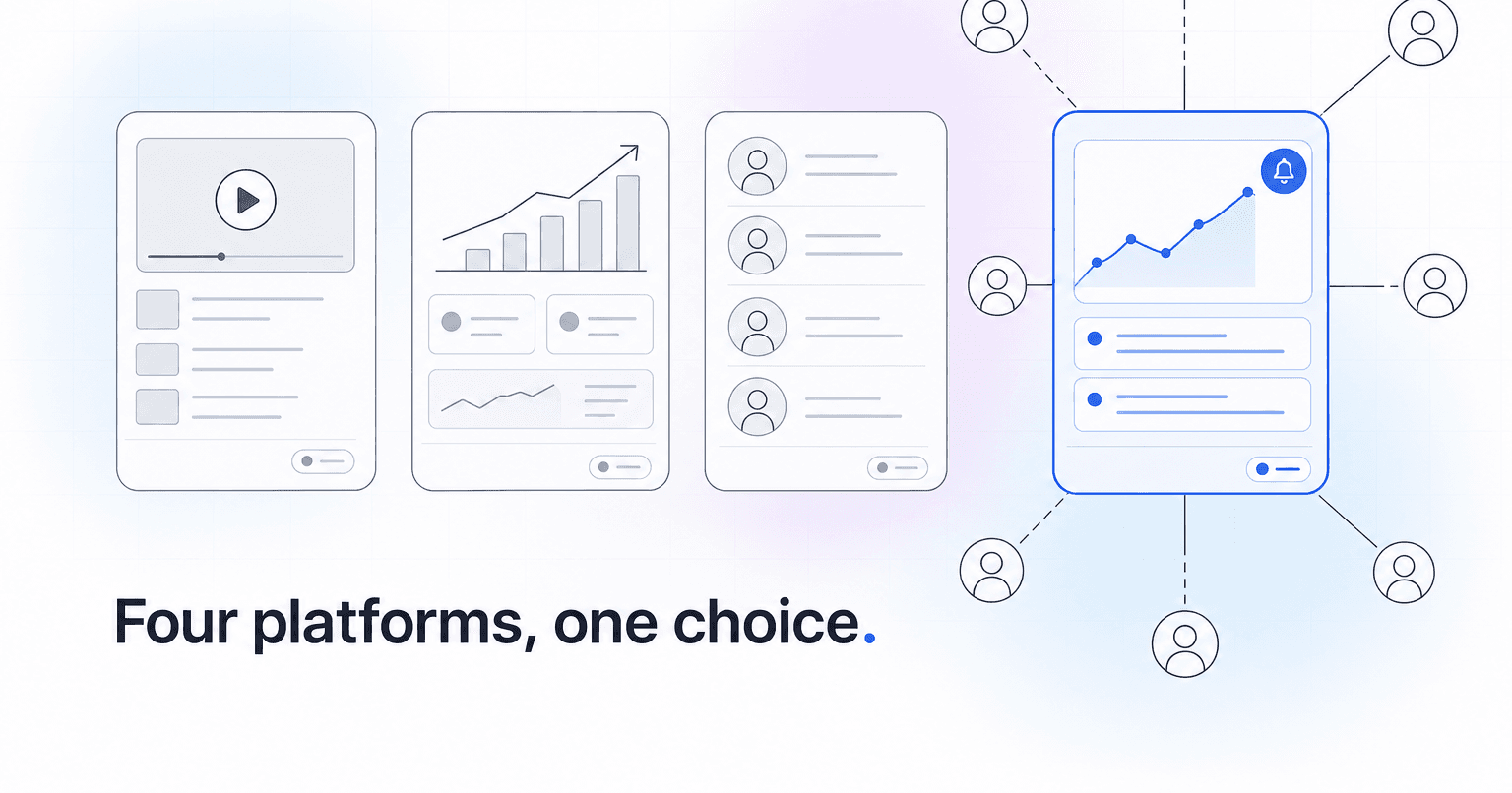
That is the part nobody tells you on a demo call. "Engagement platform" is not really a product category. It is four different categories wearing the same label. Knowing which one you are looking at saves you a year of disappointment.
The four kinds of church engagement platform
App and media-first
Subsplash, Tithe.ly's app products, and most branded church apps live here. So does Church Center, though that one is really Planning Center's front door rather than a standalone product.
These start from content delivery: sermons, livestream, push notifications, a directory, event signups. They measure engagement as app opens and sermon plays. Genuinely useful for keeping a scattered congregation connected to teaching, and push notifications reliably outperform email with members under 40.
The limit is what the metric can see. An app tells you who is present in the app, not who is quietly leaving. Someone who streams every week, gives nothing, and serves nowhere looks engaged by these numbers. Often they are three months from gone.
Giving-first
Pushpay, Tithe.ly, Givelify.
Built around the transaction, and good at it: recurring gift setup, text-to-give, pledge campaigns, year-end statements. Several have added generosity dashboards that flag lapsed givers.
The limit is timing. Giving is a lagging indicator. By the time a monthly gift stops, the relationship usually cooled months earlier. Giving data is a critical input to engagement, but a platform that only sees dollars is reading the last chapter of the story. We wrote up the giving-first tradeoff in more detail here.
ChMS-first
Planning Center, Breeze, Church Community Builder.
The system of record. People, households, check-ins, volunteer scheduling, groups, workflows. If your data is anywhere, it is here, and these tools are very good at what they do.
The limit is posture. A ChMS reports the past accurately and then waits for you to ask the right question. Planning Center will tell you attendance dropped if you build the list. It will not walk into your Tuesday staff meeting and hand you eleven names. Reporting is not the same as noticing.
Prediction-first
A newer and thinner group: ChurchAI, plus the analytics add-ons some ChMS vendors have started bolting on.
These sit on top of the record and score behavior. The job is to find the pattern that precedes leaving inside your congregation, then trigger the follow-up. Attendance gap, plus lapsed serving, plus three unopened messages, equals a flag, and it fires before the giving stops. If the underlying math is unfamiliar, our primer on engagement scoring covers what these numbers do and do not mean.
The limit is data. Prediction is only as good as what feeds it. A church with three years of clean check-in history gets far more out of it than one that started tracking attendance last month.
The criteria that actually decide whether engagement improves
- Unified record. Can one screen answer when a member last attended, gave, served, and responded? If those four facts live in four tools, no amount of dashboard polish helps. This is the unglamorous plumbing step everything else depends on.
- Leading or lagging signal. Ask the vendor directly: does this flag someone before or after they stop giving? Most say "after" if you keep pushing.
- Does it act, or only display? A dashboard nobody opens during a busy week recovers zero members. Look for triggered texts, assigned tasks, and follow-up that survives a chaotic Advent.
- Fit with your existing stack. Ripping out Planning Center to gain engagement scoring is usually the wrong trade. Prefer tools that read from it. Here is the side-by-side on that specific decision.
- Data governance. Counseling notes, giving history, home addresses, minors' check-in records. Ask who on staff can see what, how long records are kept, and where the data physically sits. What responsible handling requires is a fair standard to hold any vendor to.
- Weekly labor cost. Every platform assumes someone does something. Find out who, and how long it takes. A solo admin at a 400-person church has maybe twenty spare minutes.
- Exit terms. Ask before you sign: can you export the full member record, including notes and giving history, in a usable format, and is the contract annual or month to month? Vendors who hesitate on that question are telling you something.
So which should you pick?
Pick app-first if your problem is reach. People are committed but hard to contact, and teaching content is your main touchpoint.
Pick giving-first if your problem is financial infrastructure. Manual counting, no recurring gifts, painful year-end statements.
Pick ChMS-first if your records are a mess. Fix the system of record before layering anything on top of it. Nothing else works until that is solved.
Pick prediction-first if your records are already decent and your real problem is that people leave quietly and you find out at Christmas. That is the gap ChurchAI was built for: it reads from Planning Center, Breeze, or Church Community Builder rather than replacing them, and turns the data you already have into a weekly list of names.
Most churches need two of these, not four. If you are running more than two overlapping tools, the next thing to cut is probably duplication rather than budget. Worth reading how the categories stack before your next renewal date comes up.
Common questions
- What is ChurchAI?
- ChurchAI is an AI-native church management platform built to help churches retain members, grow giving, and eliminate administrative busywork. Unlike legacy church software that stores data passively, ChurchAI acts as an intelligence layer that connects to your existing tools, analyzes engagement patterns, predicts churn, identifies emerging donors and volunteer leaders, and automates follow-up workflows.
- How is ChurchAI different from Planning Center or other church management software?
- Most church management software like Planning Center, Rock CHMS, or Subsplash are built for administration and reporting. They store data but don't act on it. ChurchAI is built for discipleship and growth. It uses AI to proactively surface insights, predict which members are at risk of leaving, identify first-time and emerging givers, recommend volunteer candidates, and trigger automated follow-up communications. ChurchAI integrates with your existing tools and serves as the command center that turns church data into action.
- Does ChurchAI replace my current church software?
- No. ChurchAI connects directly with your existing church tools including Planning Center, Rock CHMS, Subsplash, Mailchimp, Microsoft Fabric, Power BI, and others. It acts as the intelligence layer on top of your current tech stack, unifying data from scattered systems into one command center without requiring you to switch platforms.
- What problems does ChurchAI solve for churches?
- ChurchAI solves three core problems: (1) Member churn — it identifies disengaged members early through attendance and engagement pattern analysis, then triggers automated follow-up before people fall through the cracks. (2) Missed growth opportunities — it surfaces emerging donors, first-time givers, and potential volunteer leaders that pastors would otherwise miss. (3) Administrative overload — it automates follow-ups, people management, growth tracks, and reporting so church staff can focus on ministry instead of spreadsheets.
- What size churches does ChurchAI work for?
- ChurchAI works for churches of all sizes, from growing congregations to enterprise-level megachurches with multiple campuses and complex tech stacks. The platform scales to handle multi-campus operations with thousands of members, multiple data systems, and sophisticated reporting needs.
- Is ChurchAI an AI chatbot for churches?
- No. ChurchAI is not a chatbot or a simple Q&A tool. It is a full AI-native platform with intelligent agents that analyze church data, score member engagement, predict behavior patterns, automate workflows, and deliver actionable insights. Think of it as an AI-powered Executive Pastor that monitors church health 24/7 and proactively surfaces what needs attention.
- What AI technology does ChurchAI use?
- ChurchAI uses AI-native architecture including large language models, engagement scoring models, predictive analytics for churn and giving patterns, and automated workflow agents. The platform's domain expertise is encoded directly into its AI workflows, prompts, and scoring models, built by founders with over a decade of church leadership experience. This creates a data flywheel where the more churches use ChurchAI, the smarter its predictions and recommendations become.
- How do I get started with ChurchAI?
- Visit churchai.com to request a demo. The ChurchAI team will walk you through the platform, understand your current tech stack and church needs, and show how ChurchAI integrates with your existing tools to deliver immediate value.