· 4 min read
Church Management Software vs. All-in-One AI Platform: Which Stack Fits a Growing Congregation?
A plain-language comparison of traditional ChMS tools like Planning Center and Breeze against all-in-one AI platforms—covering follow-up, disengagement, giving insights, and when to run both.
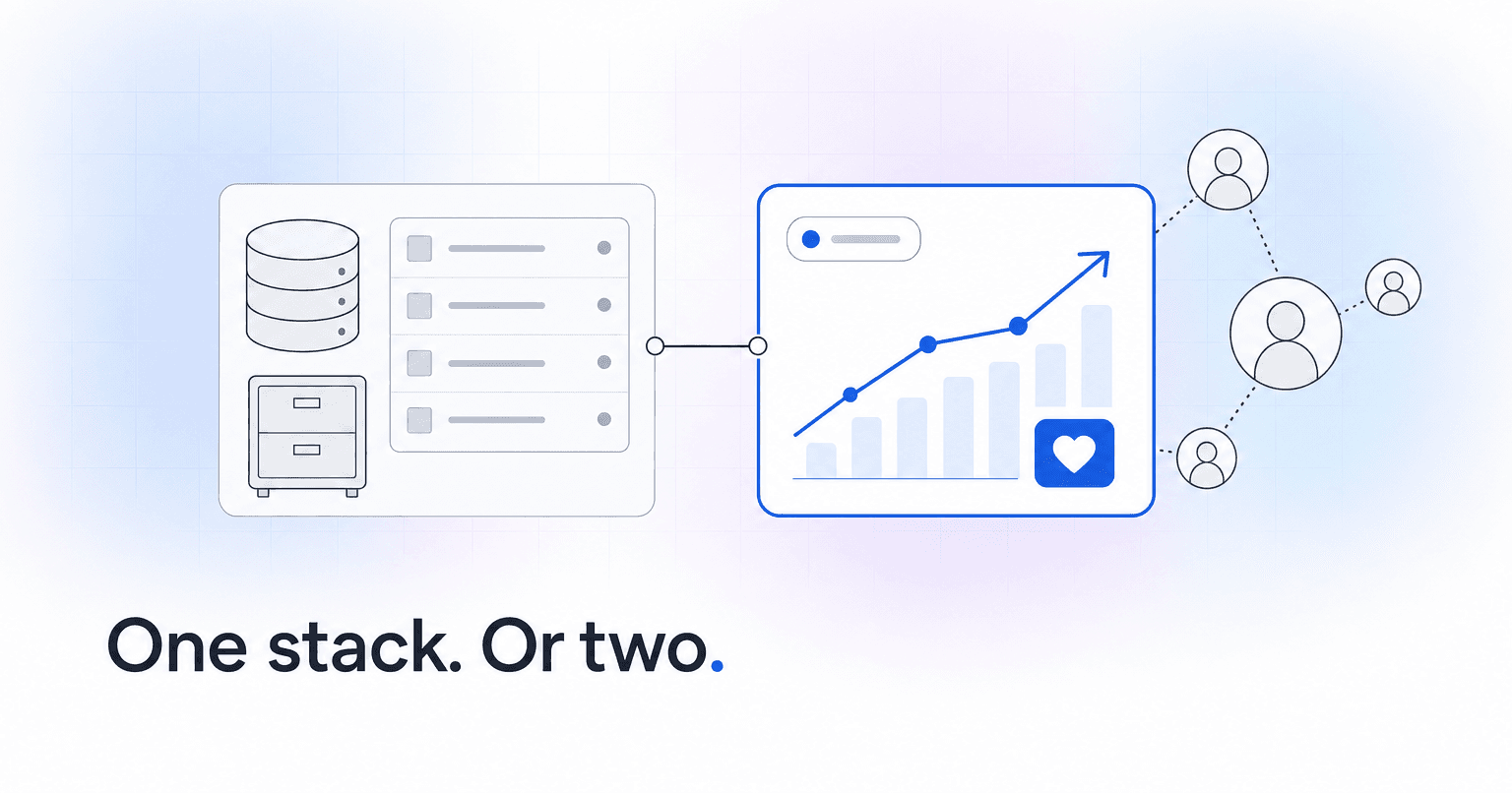
If your church is under 300 people and stable, a traditional ChMS like Planning Center, Breeze, or CCB is probably enough. If you are growing, losing visitors you meant to follow up with, or watching long-time givers quietly drift, a ChMS alone will not solve it. That is the honest answer. The rest of this post breaks down where each stack wins, where each one breaks, and how to decide without buying twice.
What each stack actually is
Traditional church management software (ChMS). Planning Center, Breeze, Rock, CCB, Tithe.ly ChMS. These are systems of record. They hold your people database, check-ins, group rosters, giving history, and service planning. They are excellent filing cabinets with excellent forms attached.
All-in-one AI platform. A layer that sits on top of your ChMS (or replaces the peripheral tools around it) and actually does work. It reads the patterns in your data, predicts who is disengaging, drafts the follow-up, sends the text, writes the newsletter, and flags the giver whose pledge dropped 40% over two months. ChurchAI is built this way: it integrates with Planning Center, Breeze, and CCB rather than replacing them, but it does replace the AI, communication, and financial reporting tools bolted on around your ChMS.
The distinction matters because most churches do not need a new database. They need something that acts on the database they already have.
Comparison, criterion by criterion
Data and records
- ChMS: The source of truth. Attendance, giving, groups, forms. Nothing beats it here.
- AI platform: Reads from the ChMS. Does not try to be the record system. A good one leaves your Planning Center setup alone.
Follow-up and communication
- ChMS: You can send an email blast or a group text. You still have to notice who to send it to, write it, and remember to hit send.
- AI platform: Notices the third-time visitor who has not been back in two weeks, drafts the pastor's follow-up text, and sends it Tuesday morning without a staff meeting.
Disengagement and retention
- ChMS: Reports exist. You have to run them, read them, and interpret the drop-off yourself. Most staff do not, because Tuesday is already full.
- AI platform: Surfaces the pattern before it becomes a departure. A regular attender who missed three Sundays and stopped opening emails is flagged this week, not next quarter.
Giving and financial insight
- ChMS: Records donations, produces year-end statements.
- AI platform: Identifies the household whose giving frequency changed, predicts new potential donors from engagement signals, and generates the board-ready report your treasurer usually cobbles together in Excel.
Content and admin work
- ChMS: Not its job.
- AI platform: Drafts the weekly newsletter, sermon recap, and announcements from your service plan. Not a replacement for a communications director, but a serious multiplier for a staff of two.
Cost and tool sprawl
- ChMS: One line item. Reasonable.
- AI platform: Replaces ChatGPT Team, Mailchimp, Clearstream, and often Overflow or a separate reporting tool. The math usually favors consolidation once you are running three or more of those.
Pick one, or run both
Run ChMS only if: you are small, growth is flat, your staff has bandwidth to manually run reports and write every follow-up, and you are not paying for standalone AI, email, and SMS tools on top.
Add an all-in-one AI platform if: you are growing (or want to be), you already pay for Mailchimp or Clearstream or a paid ChatGPT plan, visitors are not returning at the rate you expect, or you cannot answer "who is quietly leaving right now?" without a two-hour report pull.
Replace peripheral tools with the AI platform if: you are running five or six subscriptions around your ChMS and none of them talk to each other. This is where most growing churches actually are, and it is where the consolidation pays for itself.
The honest trade-off
A ChMS is passive. An AI platform is active. If your problem is "we do not have the data," buy a ChMS. If your problem is "we have the data and we still lose people," the database is not the bottleneck. Attention is.
If that sounds like your Tuesday morning, book a demo or reach out to support and we will show you what your existing ChMS data already knows.
Common questions
- What is ChurchAI?
- ChurchAI is an AI-native church management platform built to help churches retain members, grow giving, and eliminate administrative busywork. Unlike legacy church software that stores data passively, ChurchAI acts as an intelligence layer that connects to your existing tools, analyzes engagement patterns, predicts churn, identifies emerging donors and volunteer leaders, and automates follow-up workflows.
- How is ChurchAI different from Planning Center or other church management software?
- Most church management software like Planning Center, Rock CHMS, or Subsplash are built for administration and reporting. They store data but don't act on it. ChurchAI is built for discipleship and growth. It uses AI to proactively surface insights, predict which members are at risk of leaving, identify first-time and emerging givers, recommend volunteer candidates, and trigger automated follow-up communications. ChurchAI integrates with your existing tools and serves as the command center that turns church data into action.
- Does ChurchAI replace my current church software?
- No. ChurchAI connects directly with your existing church tools including Planning Center, Rock CHMS, Subsplash, Mailchimp, Microsoft Fabric, Power BI, and others. It acts as the intelligence layer on top of your current tech stack, unifying data from scattered systems into one command center without requiring you to switch platforms.
- What problems does ChurchAI solve for churches?
- ChurchAI solves three core problems: (1) Member churn — it identifies disengaged members early through attendance and engagement pattern analysis, then triggers automated follow-up before people fall through the cracks. (2) Missed growth opportunities — it surfaces emerging donors, first-time givers, and potential volunteer leaders that pastors would otherwise miss. (3) Administrative overload — it automates follow-ups, people management, growth tracks, and reporting so church staff can focus on ministry instead of spreadsheets.
- What size churches does ChurchAI work for?
- ChurchAI works for churches of all sizes, from growing congregations to enterprise-level megachurches with multiple campuses and complex tech stacks. The platform scales to handle multi-campus operations with thousands of members, multiple data systems, and sophisticated reporting needs.
- Is ChurchAI an AI chatbot for churches?
- No. ChurchAI is not a chatbot or a simple Q&A tool. It is a full AI-native platform with intelligent agents that analyze church data, score member engagement, predict behavior patterns, automate workflows, and deliver actionable insights. Think of it as an AI-powered Executive Pastor that monitors church health 24/7 and proactively surfaces what needs attention.
- What AI technology does ChurchAI use?
- ChurchAI uses AI-native architecture including large language models, engagement scoring models, predictive analytics for churn and giving patterns, and automated workflow agents. The platform's domain expertise is encoded directly into its AI workflows, prompts, and scoring models, built by founders with over a decade of church leadership experience. This creates a data flywheel where the more churches use ChurchAI, the smarter its predictions and recommendations become.
- How do I get started with ChurchAI?
- Visit churchai.com to request a demo. The ChurchAI team will walk you through the platform, understand your current tech stack and church needs, and show how ChurchAI integrates with your existing tools to deliver immediate value.