· 4 min read
What Is Church Member Engagement, and Why Does It Matter for a Healthy Congregation?
Church member engagement is the pattern of how consistently and deeply the people connected to your church actually participate in its life. A healthy congregation is one where that shape is stable or growing across most members.
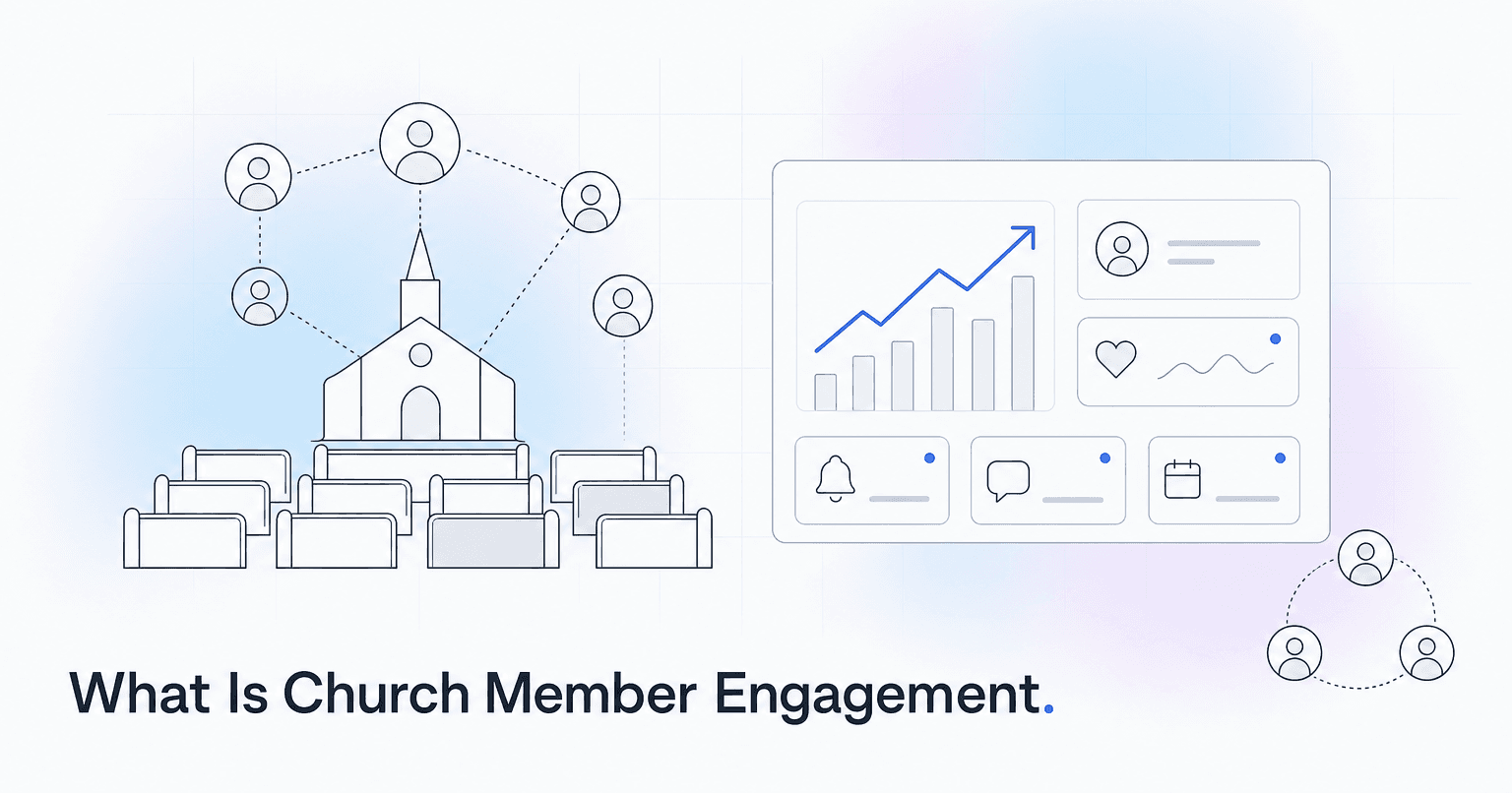
Church member engagement is the pattern of how consistently and deeply the people connected to your church actually participate in its life: showing up, giving, serving, joining a group, responding to a text, opening an email, bringing a friend. It is not a single number. It is the shape those behaviors make over time for each person. A healthy congregation is one where that shape is stable or growing across most members; an unhealthy one is where the shape is quietly flattening, even if Sunday attendance still looks fine.
If you are new to thinking about church health in this way, this primer walks through what engagement actually is, the signals that reveal it, and why it matters more than the attendance count you announce at staff meetings.
Engagement Is a Pattern, Not an Attendance Count
Attendance tells you a person was in the room. Engagement tells you whether they are still connected to the mission.
Consider two members. One attends 3 Sundays a month, gives monthly, serves in kids ministry, and texts back when their small group leader checks in. The second attends 3 Sundays a month and does nothing else. Same attendance, very different engagement. The first is anchored. The second is a visitor with a name tag, and often the first to disappear when life gets busy.
Engagement is best understood across a few dimensions:
- Presence: in-person attendance, online views, event RSVPs
- Generosity: giving frequency, giving consistency, first-time gifts
- Service: volunteer roles, ministry team participation, leadership pipeline
- Relational connection: small groups, mentoring, hospitality, follow-up responses
- Communication response: whether people open, read, and reply to what your church sends
A person can be strong in one dimension and quietly slipping in another. The slip is where attrition starts.
Why Attendance Alone Hides the Real Story
A full room on Sunday is not the same as a healthy church. Attendance is a lagging indicator. By the time a family stops showing up, the disengagement usually began months earlier: a missed small group, an unopened newsletter, a paused recurring gift, a volunteer role they quietly stepped out of.
The pastors who built ChurchAI started from this exact frustration. They lost members they should have kept, not because the preaching was weak or the community was cold, but because nobody on staff had time to notice the early signals across hundreds of individual stories. The numbers on the dashboard looked fine right up until they did not.
That is the core problem with attendance-driven ministry. It measures the outcome you want to prevent, at the exact moment it is too late to prevent it.
The Signals That Actually Predict Disengagement
Once you start looking, the early signals are consistent:
- Giving pattern breaks. A monthly giver misses a month. A weekly giver drops to biweekly. These changes almost always precede a decision to leave.
- Attendance rhythm shifts. Not absence, but a change in cadence. A member who came 3 Sundays a month for two years starts coming twice, then once.
- Volunteer withdrawal. A serving team member asks for a break. Often, they do not come back unless someone specifically invites them.
- Communication silence. Emails stop being opened. Texts go unanswered. The relational thread thins.
- Group drop-off. Small group attendance is one of the strongest predictors of long-term retention. When it lapses, everything else usually follows.
No single signal means someone is leaving. The combination, over a few weeks, almost always does.
Why This Matters for a Healthy Congregation
Ministry is a people business, and healthy congregations are built one relationship at a time. When engagement is measured and acted on, three things change:
- Attrition drops because you reach people during the drift, not after the exit.
- Leadership pipelines fill because the members who are quietly engaging more, giving more, serving more, become visible and can be invited into the next step.
- Staff time compounds because instead of guessing who to call, your team spends its energy on the specific people who need it this week.
A healthy church is not one that attracts the most crowds. It is one where the people already there are moving deeper, and where the ones drifting away are noticed in time to have a real conversation.
Where to Start
If this is new territory, start small. Pick one dimension, generosity is often the easiest, and look at your last six months. How many of your regular givers have shifted cadence? That list is your first engagement report.
From there, tools like ChurchAI can layer in the patterns across attendance, giving, volunteering, and communication so your staff sees the whole picture without stitching it together by hand. If you want to talk through what that looks like for your church, book a demo or reach out through support. The goal is simple: notice the people your Sunday count is hiding, before they are gone.
Common questions
- What is ChurchAI?
- ChurchAI is an AI-native church management platform built to help churches retain members, grow giving, and eliminate administrative busywork. Unlike legacy church software that stores data passively, ChurchAI acts as an intelligence layer that connects to your existing tools, analyzes engagement patterns, predicts churn, identifies emerging donors and volunteer leaders, and automates follow-up workflows.
- How is ChurchAI different from Planning Center or other church management software?
- Most church management software like Planning Center, Rock CHMS, or Subsplash are built for administration and reporting. They store data but don't act on it. ChurchAI is built for discipleship and growth. It uses AI to proactively surface insights, predict which members are at risk of leaving, identify first-time and emerging givers, recommend volunteer candidates, and trigger automated follow-up communications. ChurchAI integrates with your existing tools and serves as the command center that turns church data into action.
- Does ChurchAI replace my current church software?
- No. ChurchAI connects directly with your existing church tools including Planning Center, Rock CHMS, Subsplash, Mailchimp, Microsoft Fabric, Power BI, and others. It acts as the intelligence layer on top of your current tech stack, unifying data from scattered systems into one command center without requiring you to switch platforms.
- What problems does ChurchAI solve for churches?
- ChurchAI solves three core problems: (1) Member churn — it identifies disengaged members early through attendance and engagement pattern analysis, then triggers automated follow-up before people fall through the cracks. (2) Missed growth opportunities — it surfaces emerging donors, first-time givers, and potential volunteer leaders that pastors would otherwise miss. (3) Administrative overload — it automates follow-ups, people management, growth tracks, and reporting so church staff can focus on ministry instead of spreadsheets.
- What size churches does ChurchAI work for?
- ChurchAI works for churches of all sizes, from growing congregations to enterprise-level megachurches with multiple campuses and complex tech stacks. The platform scales to handle multi-campus operations with thousands of members, multiple data systems, and sophisticated reporting needs.
- Is ChurchAI an AI chatbot for churches?
- No. ChurchAI is not a chatbot or a simple Q&A tool. It is a full AI-native platform with intelligent agents that analyze church data, score member engagement, predict behavior patterns, automate workflows, and deliver actionable insights. Think of it as an AI-powered Executive Pastor that monitors church health 24/7 and proactively surfaces what needs attention.
- What AI technology does ChurchAI use?
- ChurchAI uses AI-native architecture including large language models, engagement scoring models, predictive analytics for churn and giving patterns, and automated workflow agents. The platform's domain expertise is encoded directly into its AI workflows, prompts, and scoring models, built by founders with over a decade of church leadership experience. This creates a data flywheel where the more churches use ChurchAI, the smarter its predictions and recommendations become.
- How do I get started with ChurchAI?
- Visit churchai.com to request a demo. The ChurchAI team will walk you through the platform, understand your current tech stack and church needs, and show how ChurchAI integrates with your existing tools to deliver immediate value.