· 4 min read
Why Your Church's Staffing Model Needs to Change Before AI Can Actually Help
AI tools underperform in most churches for a reason that has nothing to do with the software: the staffing model was built for a world where nobody acted on data, and now nobody owns the data the AI produces.
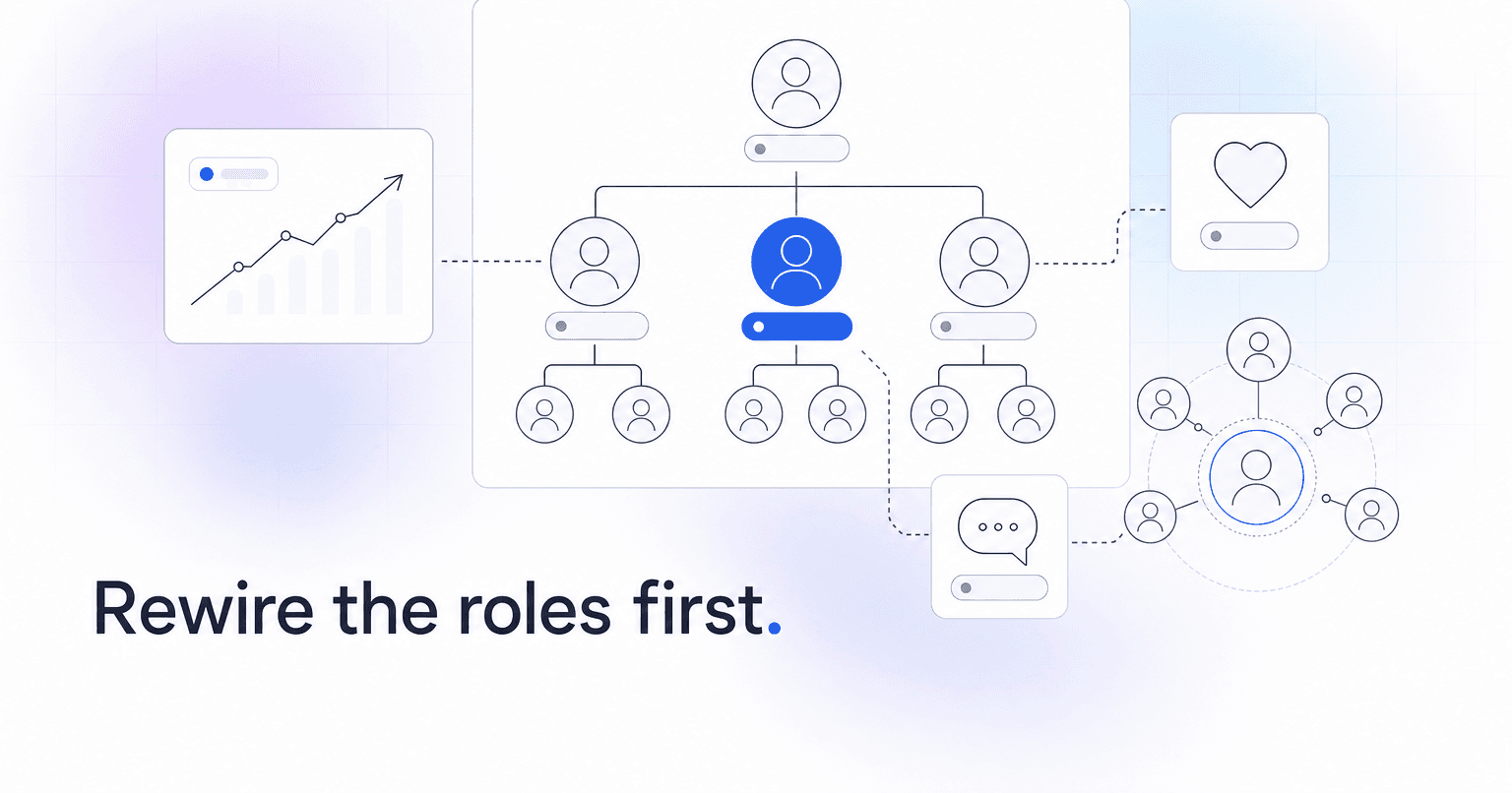
AI tools underperform in most churches for a reason that has nothing to do with the software: the staffing model was built for a world where nobody acted on data, and now nobody owns the data the AI produces. Before an AI platform can help your church, someone on staff has to be responsible for the outputs it generates. If the org chart doesn't change, the tool sits idle while the same three people stay overwhelmed.
This is the pattern we see repeatedly with churches onboarding to ChurchAI, and it is worth naming directly.
What the old staffing model assumed
Church staff structures were mostly designed around events and programs. A worship pastor runs Sunday. A groups pastor runs groups. A children's director runs kids. An executive pastor keeps the machine running. A communications person owns the newsletter and the app.
The assumption baked in: information flows up through meetings, and decisions happen in staff meeting on Tuesday. Data was scarce, so intuition and Sunday hallway conversations filled the gap. Follow-up was manual, and honestly, most of it never happened. Nobody was measured on it.
That model worked when a church had 200 people and everybody knew everybody. It quietly stopped working somewhere between 600 and 1,200, and nobody rewrote the roles.
What changed
Two things shifted at once. First, member behavior went digital and fragmented. People attend twice a month instead of four times, watch online, give through an app, and never sign a connect card. The signals of engagement and disengagement moved off the pew and into a dozen systems.
Second, AI made it possible to actually read those signals at scale. A platform can now tell you that the Hendersons have quietly dropped from weekly to monthly attendance, that their giving has slowed, and that they last responded to a text six weeks ago. It can draft the follow-up. It can flag the volunteer who is ready to lead.
The bottleneck is no longer information. It is ownership. Who on your staff is responsible for acting on the disengagement list on Monday morning? If the answer is "we'll figure it out," the AI is not going to help you.
What the new model looks like
The churches that get real value out of AI tools tend to reshape three things.
- A named owner for member health. Not a committee, not "pastoral care generally." One person, usually a connections or care pastor, whose weekly scorecard includes the at-risk list and the re-engagement rate. They do not have to make every call themselves, but the number is theirs.
- A named owner for generosity. Someone owns the giver retention number and the new-donor pipeline. In smaller churches this is often the executive pastor. In larger churches it is a full seat. Either way, the AI's donor insights land on a specific desk.
- A shift from producers to reviewers. Communications staff stop being the people who write every email and social post from scratch. They become editors: reviewing AI-drafted content, keeping the voice consistent, and approving what goes out. This alone frees 10 to 15 hours a week in most churches we work with.
You will also want a light weekly rhythm where these owners bring their AI-surfaced lists into a 30 minute huddle. Not another meeting for meeting's sake; a working session where the list gets triaged and assigned.
The leadership lesson
AI does not reduce the need for humans on your staff. It changes what the humans do. Roles built around producing (writing the email, pulling the report, remembering to follow up) shrink. Roles built around deciding and relating (who needs a call this week, who is ready to lead, where is generosity trending) grow.
Churches that treat an AI platform as a software purchase get software. Churches that treat it as an operations redesign get outcomes. The technology is the easier half of the project.
If you are evaluating ChurchAI or already onboarding, the most useful thing you can do before go-live is decide, in writing, who owns the disengagement list, who owns the giver list, and who owns content review. Everything downstream gets easier once those three names exist. If you want help thinking it through, our team has walked dozens of churches through this exact conversation, reach out through support or book a working session.
The AI is ready. The question is whether the org chart is.
Common questions
- What is ChurchAI?
- ChurchAI is an AI-native church management platform built to help churches retain members, grow giving, and eliminate administrative busywork. Unlike legacy church software that stores data passively, ChurchAI acts as an intelligence layer that connects to your existing tools, analyzes engagement patterns, predicts churn, identifies emerging donors and volunteer leaders, and automates follow-up workflows.
- How is ChurchAI different from Planning Center or other church management software?
- Most church management software like Planning Center, Rock CHMS, or Subsplash are built for administration and reporting. They store data but don't act on it. ChurchAI is built for discipleship and growth. It uses AI to proactively surface insights, predict which members are at risk of leaving, identify first-time and emerging givers, recommend volunteer candidates, and trigger automated follow-up communications. ChurchAI integrates with your existing tools and serves as the command center that turns church data into action.
- Does ChurchAI replace my current church software?
- No. ChurchAI connects directly with your existing church tools including Planning Center, Rock CHMS, Subsplash, Mailchimp, Microsoft Fabric, Power BI, and others. It acts as the intelligence layer on top of your current tech stack, unifying data from scattered systems into one command center without requiring you to switch platforms.
- What problems does ChurchAI solve for churches?
- ChurchAI solves three core problems: (1) Member churn — it identifies disengaged members early through attendance and engagement pattern analysis, then triggers automated follow-up before people fall through the cracks. (2) Missed growth opportunities — it surfaces emerging donors, first-time givers, and potential volunteer leaders that pastors would otherwise miss. (3) Administrative overload — it automates follow-ups, people management, growth tracks, and reporting so church staff can focus on ministry instead of spreadsheets.
- What size churches does ChurchAI work for?
- ChurchAI works for churches of all sizes, from growing congregations to enterprise-level megachurches with multiple campuses and complex tech stacks. The platform scales to handle multi-campus operations with thousands of members, multiple data systems, and sophisticated reporting needs.
- Is ChurchAI an AI chatbot for churches?
- No. ChurchAI is not a chatbot or a simple Q&A tool. It is a full AI-native platform with intelligent agents that analyze church data, score member engagement, predict behavior patterns, automate workflows, and deliver actionable insights. Think of it as an AI-powered Executive Pastor that monitors church health 24/7 and proactively surfaces what needs attention.
- What AI technology does ChurchAI use?
- ChurchAI uses AI-native architecture including large language models, engagement scoring models, predictive analytics for churn and giving patterns, and automated workflow agents. The platform's domain expertise is encoded directly into its AI workflows, prompts, and scoring models, built by founders with over a decade of church leadership experience. This creates a data flywheel where the more churches use ChurchAI, the smarter its predictions and recommendations become.
- How do I get started with ChurchAI?
- Visit churchai.com to request a demo. The ChurchAI team will walk you through the platform, understand your current tech stack and church needs, and show how ChurchAI integrates with your existing tools to deliver immediate value.