· 6 min read
Why Can't We Get People to Volunteer at Church Anymore? (And How to Find New Leaders Without Asking the Same 20%)
People still volunteer. What changed is how they commit, and most churches are still recruiting for the old pattern — exhausting the same 20% while the other 80% never gets a specific, bounded ask.
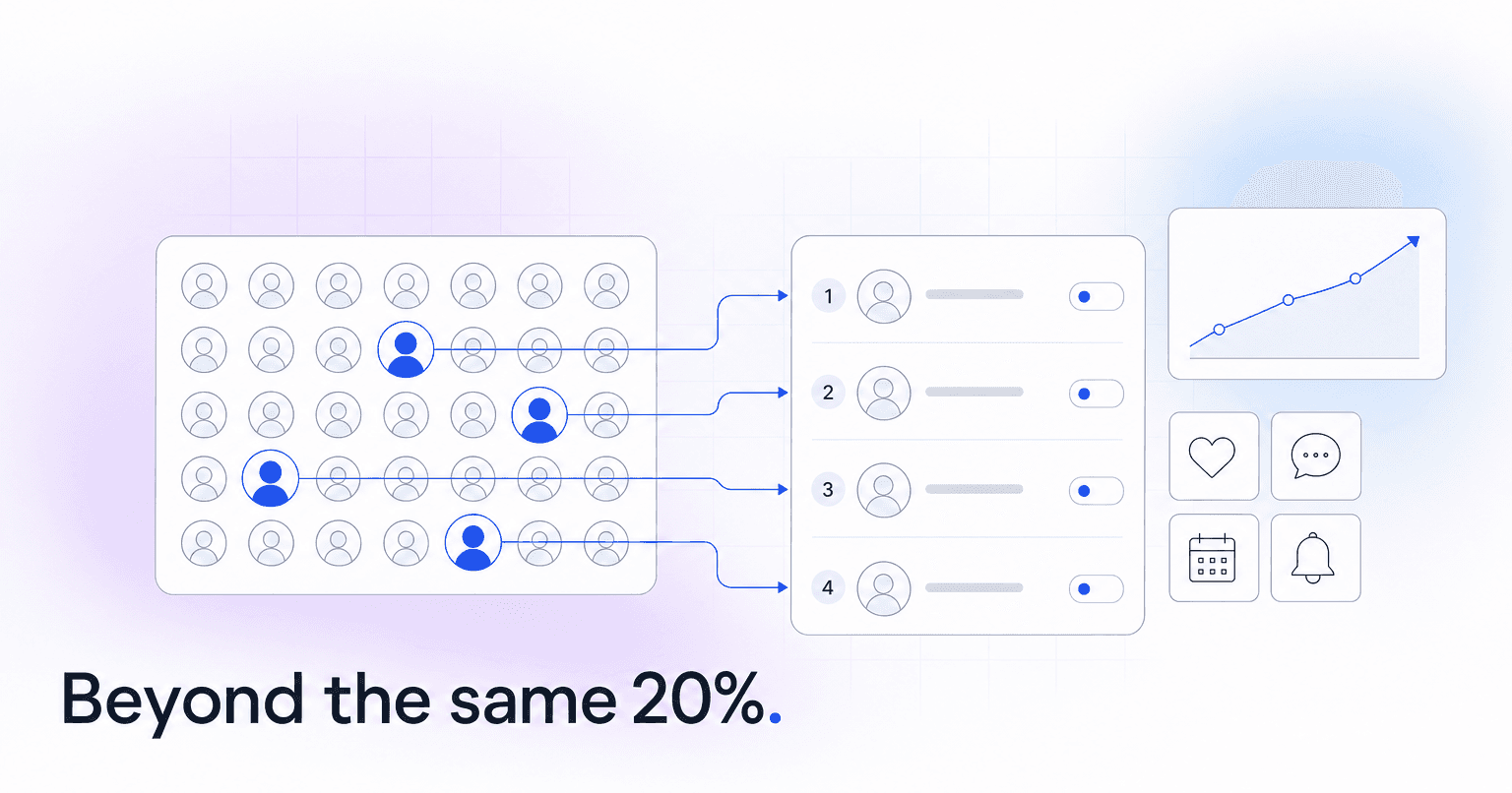
People still volunteer. What changed is how they commit, and most churches are still recruiting for the old pattern.
The member who shows up twice a month is not less devoted than the member who showed up four times a month in 2015. But a "once a month" serving slot now costs that person half their Sundays. That arithmetic is doing more damage to your volunteer roster than any decline in commitment. Then there is where the ask happens. Pulpit announcements and a folding table in the lobby reach the people already standing closest to the stage, which is the same 20% you keep exhausting. The method guarantees the outcome.
So the fix is not a louder recruitment push. It is a repeatable way to see which of the other 80% are already showing signs of readiness, followed by a bounded, specific ask aimed at them.
Why has volunteer recruitment gotten harder?
Not because commitment collapsed. Because the mechanics changed underneath you.
- Attendance frequency dropped, so the denominator shrank. A member who attends twice a month is present for half the Sundays you need covered. Your "regulars" list is the same size on paper and half the size in practice.
- Livestream created a committed group you never see. People who watch online, give consistently, and answer texts are engaged. They also never walk past the sign-up table. They are invisible to every recruitment method that depends on physical presence.
- The ask got vaguer as the need got louder. "We desperately need volunteers" signals a broken system. Capable people avoid volunteering into chaos, especially when they suspect the role has no end date.
- Onboarding friction eats the yeses you already won. Background check, training video, policy acknowledgment. If that takes three weeks and two reminder emails, a real percentage of the people who said yes never make it to a first shift. Nobody records those as declines, so nobody fixes it.
Is the 80/20 rule actually true in churches?
Directionally, yes, and it is usually worse at the leadership level than at the general serving level. Ask a volunteer coordinator to name everyone who has led a team in the last three years. Most can do it from memory in under a minute, which tells you the size of the bench.
The distortion is largely self-inflicted. A handful of people said yes once, so they became the default ask: known, reachable, unlikely to decline. Every subsequent yes narrows the pool further. That is not a spiritual maturity problem in your congregation. It is a visibility problem in your process.
How do we identify potential leaders in the other 80%?
Stop looking for enthusiasm. Start looking for consistency signals you already collect:
- Attendance that is regular rather than frequent (steady twice a month beats sporadic weekly)
- Small group or class participation sustained over six months or more
- Giving that started recently and repeated at least three times, which signals ownership
- Event attendance beyond weekend services: serve days, workshops, membership classes
- Response to church communication, meaning they open, reply, or RSVP
Any one of those alone means almost nothing. Two or three together, held steady over a quarter, describes someone who is already invested and has never been asked. That combination is essentially what an engagement score captures, and it is why churches that run scoring keep surfacing names their staff genuinely did not expect. One mid-sized church working this way found three new ministry leaders in six months, none of whom had ever filled out a serving card.
What kind of ask actually gets a yes?
Named, specific, bounded. Compare these two.
"We need help in kids ministry."
"Would you take the 9:30 second-grade room, one Sunday a month, September through December? Marcus leads the team and will train you the first week."
The second converts far better because it answers the four questions every hesitant person is asking silently: what exactly, how often, for how long, and who is with me. Give every role an explicit end date, even when you hope the person renews. Term limits are the cheapest burnout fix available to you, and they make the yes easier because it is not a life sentence.
How do we know a current volunteer is about to quit?
They stop showing up before they tell you. The sequence is remarkably consistent. A missed shift with a good reason. Then a swap request. Then declining replies to team communication. Then attendance itself thins out. That whole arc usually plays out over eight to twelve weeks.
Track only who served on Sunday and you catch it at the end, when you are already recruiting a replacement. Track response rates and attendance drift together and you catch it in week three, when a five minute phone call still fixes it. Most of the volunteer tracking mistakes that burn out church leaders come down to counting completed shifts instead of watching the signals that precede a quit.
How do we hand a ministry off without losing it?
Overlap, do not swap. The outgoing leader stays through one full cycle, a semester or a season or a term, while the new person actually runs it. And write the role down: the recurring tasks, the vendor contacts, the two or three decisions only that person makes. Most church roles live entirely in one person's head, which is why a handoff feels like losing institutional memory. Two pages of notes prevents it.
Where does software fit in this?
It does not recruit anyone. It tells you who to call.
Cross-referencing attendance, giving, group participation, and communication response across a thousand records is real analysis, and no volunteer coordinator is doing it by hand on a Tuesday afternoon. That is the part worth automating. Platforms like ChurchAI sit on top of the systems you already use and produce the ranked list: who is ready, who is drifting, who has never once been asked. If you are still deciding what tooling you need, the comparison of church management software for volunteer programs is a reasonable place to start. The conversation itself is still yours to have.
Pull ten names you have never asked. Make each ask specific and time-bound. That alone breaks the loop.
Common questions
- What is ChurchAI?
- ChurchAI is an AI-native church management platform built to help churches retain members, grow giving, and eliminate administrative busywork. Unlike legacy church software that stores data passively, ChurchAI acts as an intelligence layer that connects to your existing tools, analyzes engagement patterns, predicts churn, identifies emerging donors and volunteer leaders, and automates follow-up workflows.
- How is ChurchAI different from Planning Center or other church management software?
- Most church management software like Planning Center, Rock CHMS, or Subsplash are built for administration and reporting. They store data but don't act on it. ChurchAI is built for discipleship and growth. It uses AI to proactively surface insights, predict which members are at risk of leaving, identify first-time and emerging givers, recommend volunteer candidates, and trigger automated follow-up communications. ChurchAI integrates with your existing tools and serves as the command center that turns church data into action.
- Does ChurchAI replace my current church software?
- No. ChurchAI connects directly with your existing church tools including Planning Center, Rock CHMS, Subsplash, Mailchimp, Microsoft Fabric, Power BI, and others. It acts as the intelligence layer on top of your current tech stack, unifying data from scattered systems into one command center without requiring you to switch platforms.
- What problems does ChurchAI solve for churches?
- ChurchAI solves three core problems: (1) Member churn — it identifies disengaged members early through attendance and engagement pattern analysis, then triggers automated follow-up before people fall through the cracks. (2) Missed growth opportunities — it surfaces emerging donors, first-time givers, and potential volunteer leaders that pastors would otherwise miss. (3) Administrative overload — it automates follow-ups, people management, growth tracks, and reporting so church staff can focus on ministry instead of spreadsheets.
- What size churches does ChurchAI work for?
- ChurchAI works for churches of all sizes, from growing congregations to enterprise-level megachurches with multiple campuses and complex tech stacks. The platform scales to handle multi-campus operations with thousands of members, multiple data systems, and sophisticated reporting needs.
- Is ChurchAI an AI chatbot for churches?
- No. ChurchAI is not a chatbot or a simple Q&A tool. It is a full AI-native platform with intelligent agents that analyze church data, score member engagement, predict behavior patterns, automate workflows, and deliver actionable insights. Think of it as an AI-powered Executive Pastor that monitors church health 24/7 and proactively surfaces what needs attention.
- What AI technology does ChurchAI use?
- ChurchAI uses AI-native architecture including large language models, engagement scoring models, predictive analytics for churn and giving patterns, and automated workflow agents. The platform's domain expertise is encoded directly into its AI workflows, prompts, and scoring models, built by founders with over a decade of church leadership experience. This creates a data flywheel where the more churches use ChurchAI, the smarter its predictions and recommendations become.
- How do I get started with ChurchAI?
- Visit churchai.com to request a demo. The ChurchAI team will walk you through the platform, understand your current tech stack and church needs, and show how ChurchAI integrates with your existing tools to deliver immediate value.