· 6 min read
Why Don't First-Time Visitors Come Back to Our Church? The Guest Follow-Up Mistakes That Quietly Cost You New Members
Most first-time visitors don't return because no one specific was responsible for them by Monday morning. Here are seven operational follow-up mistakes that quietly cost churches new members—and how to fix them.
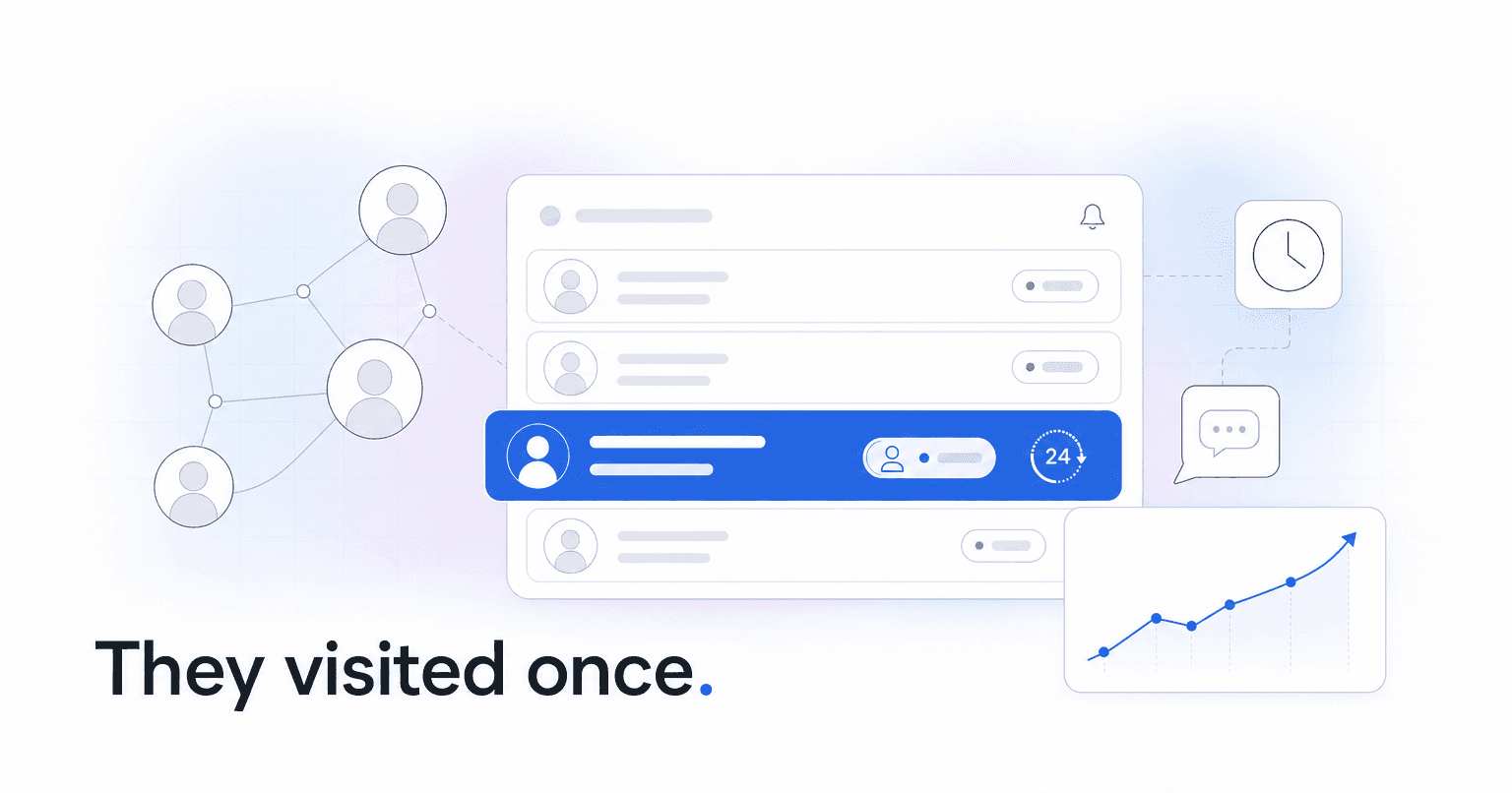
Most first-time visitors do not come back because nobody specific was responsible for them by Monday morning.
The failure is almost never the sermon or the coffee. It is operational. No named owner. A follow-up window that closes before anyone acts. A message so generic it announces that nothing about the person was noticed. And no way to tell which guests were actually warm, so a staff of four spreads the same thin effort across everybody.
Start with ownership and timing. Almost everything else on this list is downstream of those two.
Before you read further, run one piece of arithmetic on your own church. Take the first-time guest cards from a single month, say there were forty. Now count how many of those forty people you can place in the building a second time within thirty days. Most churches have never done this, and the ones that do are usually startled by the answer. If six of your forty came back, no amount of new signage or a better welcome video is going to move your growth curve. The leak is in the week after the visit, and it is fixable without hiring anyone.
Mistake 1: Follow-up belongs to "the team," so it belongs to no one
The connections director assumes the small group pastor reached out. The small group pastor assumed the greeter did. The guest hears nothing, and no one finds out for three months.
The fix: assign every guest card to a single human being by name, in writing, within 24 hours. Not a team inbox. Not a shared spreadsheet tab that four people can see and nobody edits. A person, with a due date and a visible status. If your system cannot answer "who owns this guest and what happened," you do not have a follow-up process. You have a hope.
Mistake 2: The first touch lands on Wednesday
Sunday's connection cards get typed up Tuesday, batched into an email blast Wednesday afternoon, and by then the guest has had a full work week to forget the visit. Warmth decays fast. The gap between a Sunday-afternoon text and a Wednesday email is not three days of convenience; it is the difference between a conversation and a broadcast.
Aim for the first personal touch inside 24 hours, a second inside 72, and a third before the next Sunday. Three touches in the first week will beat twelve spread over two months, every time.
Mistake 3: The message is identical for every guest
"Thanks for visiting! Here's our app."
That message tells the guest that nothing about them registered. And guests can smell a template, because they get eleven of them a week from car dealerships and dentists.
Think about who actually filled out cards last Sunday. The couple who came because their neighbor kept inviting them and they finally ran out of excuses. The widower who showed up the Sunday after his wife's funeral because the house was too quiet. The family that drove past two closer churches specifically to see whether your kids' ministry was any good. Three completely different situations, and one cheerful mass email serves none of them.
You do not need a custom letter. You need one true detail. "You mentioned your daughter is four, so I'm copying Marcy, who runs our preschool room, and she can tell you what Sunday looks like for her." That sentence takes forty seconds to write and it lands differently than anything automated.
The fix: capture one piece of context at the door, why they came, who invited them, ages of kids, and make it a requirement that the detail appears in the first message. If your card does not have a field for it, add one.
Mistake 4: You treat every guest as equally likely to return
Some guests are casually curious and were never going to come back. Others checked the giving page twice, opened three emails, and quietly attended the following week without telling anyone. Those two people should not receive the same effort from a small staff.
This is where most churches lose the plot, because the guest card is the only signal they look at, and the card is the least informative thing a warm guest generates. Repeat attendance, email opens, event RSVPs, kids check-ins, and return visits to your site say far more. Together they form a warmth pattern, which is exactly what a church engagement score is for: it tells a small team which ten of last month's forty guests are worth a personal phone call this week, instead of asking them to call all forty and burn out by Thursday.
Mistake 5: The next step you offer is bigger than the visit was
Guests get invited to a membership class, a serving team, or a men's breakfast at 7 a.m. on a Saturday. The ask carries more social risk than walking in on Sunday did, so nobody takes it.
Make the second step smaller than the first. Coffee with one person. A Sunday-morning text saying you saved them a seat. A short note from the pastor that asks one honest question and invites a reply.
Mistake 6: Follow-up stops after week one
Most churches stop working a guest the moment the welcome sequence ends. But attendance rarely dies at visit one. It dies between visits two and four, when the novelty has worn off and no actual relationship has formed yet. The guest has met a greeter and a pastor's email signature. Nobody knows their last name.
Run a 90-day path instead of a seven-day one, and define what finishing it means: joined a group, started serving, gave, attended four times. Pick one and write it down. A guest is not assimilated because you emailed them. This is the same discipline behind shifting your growth strategy from attracting visitors to retaining them, and it is the least glamorous work in the building.
Mistake 7: Nobody measures the return rate
If you cannot say what percentage of June's first-time guests attended a second time, every conversation your team has about guest follow-up is just opinion, and the loudest opinion wins.
Track one number monthly: first-time guests who returned within 30 days. Put it on the same page as giving and attendance, and review it with the same seriousness. When that number moves, you will know which of the six fixes above did it.
None of this is a knowledge problem. Your connections volunteers already know that a Sunday text beats a Wednesday blast. What they cannot do is hold seven disciplines in their heads at 12:30 on a Sunday afternoon with a stack of cards and a toddler on their hip. Ownership, timing, and warmth signals are the parts software should carry, which is the whole reason automated first-time visitor workflows exist. Let the system remember who owes what to whom. Leave the human part to the humans, while the guest still remembers your name.
Common questions
- What is ChurchAI?
- ChurchAI is an AI-native church management platform built to help churches retain members, grow giving, and eliminate administrative busywork. Unlike legacy church software that stores data passively, ChurchAI acts as an intelligence layer that connects to your existing tools, analyzes engagement patterns, predicts churn, identifies emerging donors and volunteer leaders, and automates follow-up workflows.
- How is ChurchAI different from Planning Center or other church management software?
- Most church management software like Planning Center, Rock CHMS, or Subsplash are built for administration and reporting. They store data but don't act on it. ChurchAI is built for discipleship and growth. It uses AI to proactively surface insights, predict which members are at risk of leaving, identify first-time and emerging givers, recommend volunteer candidates, and trigger automated follow-up communications. ChurchAI integrates with your existing tools and serves as the command center that turns church data into action.
- Does ChurchAI replace my current church software?
- No. ChurchAI connects directly with your existing church tools including Planning Center, Rock CHMS, Subsplash, Mailchimp, Microsoft Fabric, Power BI, and others. It acts as the intelligence layer on top of your current tech stack, unifying data from scattered systems into one command center without requiring you to switch platforms.
- What problems does ChurchAI solve for churches?
- ChurchAI solves three core problems: (1) Member churn — it identifies disengaged members early through attendance and engagement pattern analysis, then triggers automated follow-up before people fall through the cracks. (2) Missed growth opportunities — it surfaces emerging donors, first-time givers, and potential volunteer leaders that pastors would otherwise miss. (3) Administrative overload — it automates follow-ups, people management, growth tracks, and reporting so church staff can focus on ministry instead of spreadsheets.
- What size churches does ChurchAI work for?
- ChurchAI works for churches of all sizes, from growing congregations to enterprise-level megachurches with multiple campuses and complex tech stacks. The platform scales to handle multi-campus operations with thousands of members, multiple data systems, and sophisticated reporting needs.
- Is ChurchAI an AI chatbot for churches?
- No. ChurchAI is not a chatbot or a simple Q&A tool. It is a full AI-native platform with intelligent agents that analyze church data, score member engagement, predict behavior patterns, automate workflows, and deliver actionable insights. Think of it as an AI-powered Executive Pastor that monitors church health 24/7 and proactively surfaces what needs attention.
- What AI technology does ChurchAI use?
- ChurchAI uses AI-native architecture including large language models, engagement scoring models, predictive analytics for churn and giving patterns, and automated workflow agents. The platform's domain expertise is encoded directly into its AI workflows, prompts, and scoring models, built by founders with over a decade of church leadership experience. This creates a data flywheel where the more churches use ChurchAI, the smarter its predictions and recommendations become.
- How do I get started with ChurchAI?
- Visit churchai.com to request a demo. The ChurchAI team will walk you through the platform, understand your current tech stack and church needs, and show how ChurchAI integrates with your existing tools to deliver immediate value.