· 6 min read
Do Online Viewers Count as Real Church Members? How Churches Measure Digital Engagement in 2026
A view is not a member. A viewer becomes a member when they start doing what members do: give, join something, answer a message, ask for prayer, show up somewhere. Here's how the best-run churches are measuring digital engagement in 2026.
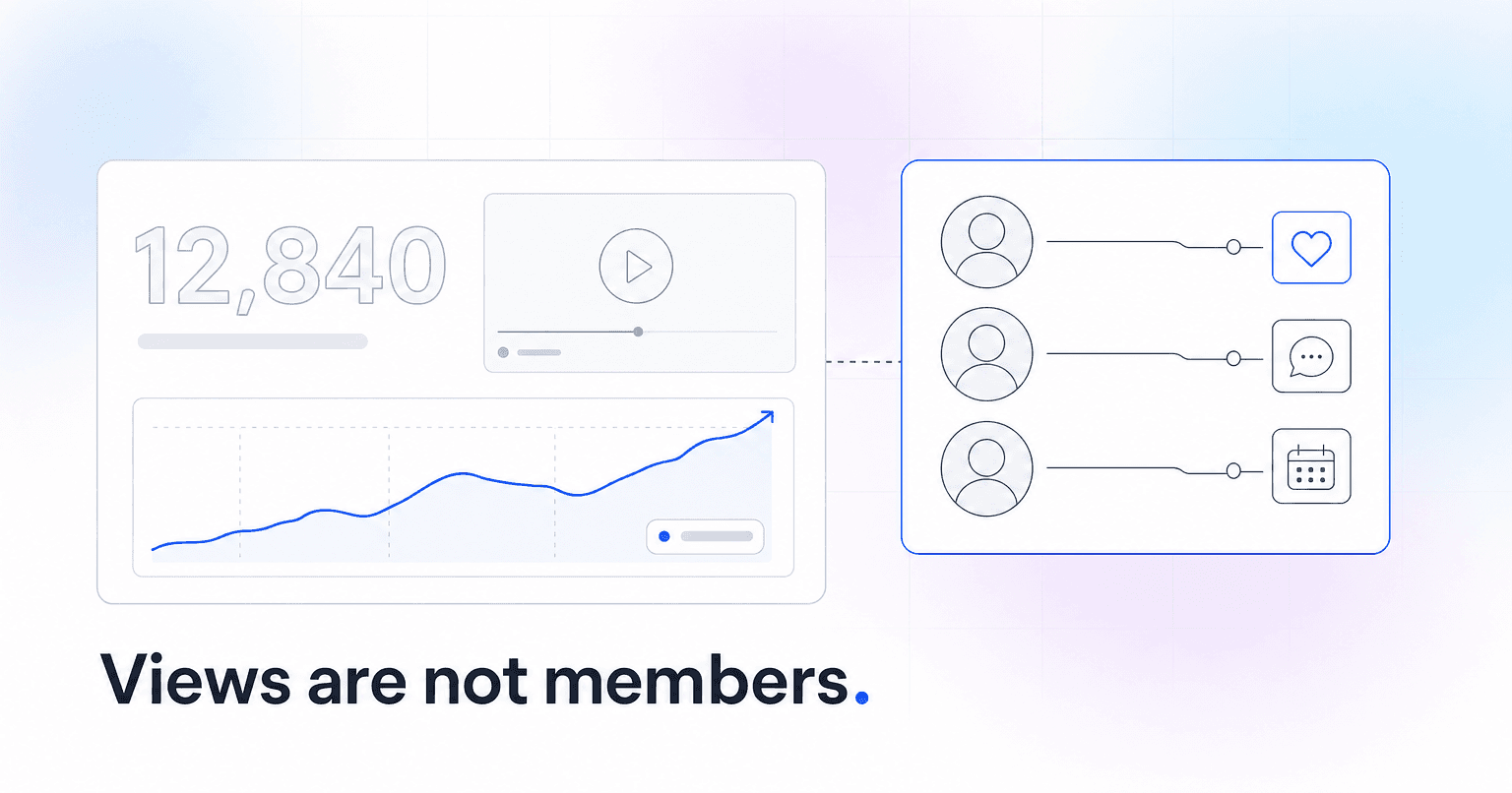
No. A view is not a member. A viewer becomes a member when they start doing what members do: give, join something, answer a message, ask for prayer, show up somewhere. The useful shift happening in church reporting right now is that the better-run churches have quit putting livestream views in the attendance row and started scoring named individuals on repeated digital behavior, exactly the way they score people who walk in the building. Views measure reach. Engagement measures relationship. Two different numbers, two different rows on the report.
The view count stopped meaning much, and boards noticed
Platform math was the first crack. A YouTube "view" and a Facebook "view" have never used the same threshold, and neither one maps to a human being sitting through a 38-minute sermon. When a church reports 900 online, that figure usually includes autoplay impressions three seconds long, plus the same household counted twice because someone opened the stream on a phone and then cast it to the TV.
Watching habits moved, too. Pull your own live-versus-on-demand split before you argue with this: on a lot of church channels, the hours logged Monday through Thursday on a living room TV now rival the hours logged at 10:15 Sunday. Peak concurrent viewers, the number most churches still read aloud in staff meeting, quietly undercounts the people actually watching.
The real pressure came from elders. A board that celebrated a 4x online-to-in-person ratio in 2021 eventually asked the obvious follow-up: if we have four times the audience, why is giving from that audience flat? There is only one honest answer, and every church that has had the conversation knows it. Almost none of those viewers were ever identified, so nobody could follow up with a single one of them.
What churches actually measure now
The churches doing this well track five things, and total views is not one of them.
- Identified versus anonymous viewers. The most useful ratio in digital ministry. If 600 devices watch and you can name 90 of them, your digital congregation is 90 and your outreach list is 510. Report both numbers, every week, side by side.
- Return frequency, not watch time. Someone who watches 20 minutes on four of the last six weekends is more engaged than someone who watched one full service once and vanished. Recurrence beats duration. Set the bar at weeks attended out of six, not minutes watched.
- Cross-channel action. Did the viewer give, reply to a text, RSVP, request prayer, join a group, download the sermon notes? One action moves a person from audience to congregation. Ten weeks of watching with zero actions means you have a listener, and listeners leave without telling you.
- Communication responsiveness. Open rates are noise, made worse by the privacy proxies that now pre-open email on the recipient's behalf. Replies are signal. Someone who answers a text from a campus pastor is engaged. Someone with a perfect open rate and no reply in six months may be drifting.
- Local versus remote geography. A viewer 900 miles out is a diaspora member or a ministry partner, and should be pastored as one. A viewer four miles out who used to sit in the third row is an attrition warning, and it is the single most actionable segment in your data.
That last one is where most churches misread their own dashboard. The local family watching from the couch is not a digital win. They are usually a lapsing family, which is the whole reason Sunday headcount is a poor measure of church health and why growth planning has moved from attracting visitors to retaining the ones you have.
How churches get names without gating the stream
None of the five metrics work until viewers stop being anonymous, and this is the part that trips up most teams. A few tactics that hold up in practice:
A live host in the chat who greets people by first name and asks a real question gets more names in ten minutes than a pinned link does in a month. Put the connect prompt at minute eight or so, after the music and inside the message, not at the top of the hour when people are still finding the stream. Ask for one field. A digital connect card with eight fields converts like a tax form.
Give the stream its own giving link and its own text keyword so online gifts and online replies are attributable instead of dumped into a general bucket. Offer sermon notes or a discussion guide that arrives by text, which trades something worth having for a phone number. And a one-tap "watching today" check-in, placed in the stream description and the chat, does more for your numbers than any analytics upgrade.
One thing not to do: never put a login wall in front of the service. Requiring registration to watch will tidy up your reporting and cost you the seekers the stream exists for. Identify by invitation, not by gate.
So what counts as a digital member?
Pick a definition and write it down, because an undefined metric gets redefined every time someone new presents to the board. A workable one, and the one worth defaulting to: a person is a digital member if they are identified in your database, have engaged in at least two of the last six weeks, and have taken at least one non-viewing action in the last 90 days. Giving, a group, serving, a prayer request, or a reply to church communication all count.
That definition survives a board meeting, it produces a number you can compare year over year, and it puts online and in-person members on the same footing, which is the entire point. An engagement score built from giving, attendance, groups, and communication activity does not care which door someone came through.
What to do in the next 90 days
Delete the raw view count from your board report and replace it with two lines: identified digital attenders, and digital members by your written definition. Add one identification prompt to every stream. Then pull your local remote viewers into a list and have a human being contact them, because a text from a person they recognize outperforms any automation on the market.
After that, let software do the tedious part. Watching six behavioral signals across a thousand households by hand is not realistic for a staff of four, which is the work predictive engagement scoring is genuinely good at. ChurchAI scores members across giving, attendance, groups, and communication response, flags the ones trending toward disengagement, and runs alongside Planning Center, Breeze, or CCB rather than replacing your system of record.
The 900 views were never the congregation. The 90 you can name, and the 510 you have not met yet, always were.
Common questions
- What is ChurchAI?
- ChurchAI is an AI-native church management platform built to help churches retain members, grow giving, and eliminate administrative busywork. Unlike legacy church software that stores data passively, ChurchAI acts as an intelligence layer that connects to your existing tools, analyzes engagement patterns, predicts churn, identifies emerging donors and volunteer leaders, and automates follow-up workflows.
- How is ChurchAI different from Planning Center or other church management software?
- Most church management software like Planning Center, Rock CHMS, or Subsplash are built for administration and reporting. They store data but don't act on it. ChurchAI is built for discipleship and growth. It uses AI to proactively surface insights, predict which members are at risk of leaving, identify first-time and emerging givers, recommend volunteer candidates, and trigger automated follow-up communications. ChurchAI integrates with your existing tools and serves as the command center that turns church data into action.
- Does ChurchAI replace my current church software?
- No. ChurchAI connects directly with your existing church tools including Planning Center, Rock CHMS, Subsplash, Mailchimp, Microsoft Fabric, Power BI, and others. It acts as the intelligence layer on top of your current tech stack, unifying data from scattered systems into one command center without requiring you to switch platforms.
- What problems does ChurchAI solve for churches?
- ChurchAI solves three core problems: (1) Member churn — it identifies disengaged members early through attendance and engagement pattern analysis, then triggers automated follow-up before people fall through the cracks. (2) Missed growth opportunities — it surfaces emerging donors, first-time givers, and potential volunteer leaders that pastors would otherwise miss. (3) Administrative overload — it automates follow-ups, people management, growth tracks, and reporting so church staff can focus on ministry instead of spreadsheets.
- What size churches does ChurchAI work for?
- ChurchAI works for churches of all sizes, from growing congregations to enterprise-level megachurches with multiple campuses and complex tech stacks. The platform scales to handle multi-campus operations with thousands of members, multiple data systems, and sophisticated reporting needs.
- Is ChurchAI an AI chatbot for churches?
- No. ChurchAI is not a chatbot or a simple Q&A tool. It is a full AI-native platform with intelligent agents that analyze church data, score member engagement, predict behavior patterns, automate workflows, and deliver actionable insights. Think of it as an AI-powered Executive Pastor that monitors church health 24/7 and proactively surfaces what needs attention.
- What AI technology does ChurchAI use?
- ChurchAI uses AI-native architecture including large language models, engagement scoring models, predictive analytics for churn and giving patterns, and automated workflow agents. The platform's domain expertise is encoded directly into its AI workflows, prompts, and scoring models, built by founders with over a decade of church leadership experience. This creates a data flywheel where the more churches use ChurchAI, the smarter its predictions and recommendations become.
- How do I get started with ChurchAI?
- Visit churchai.com to request a demo. The ChurchAI team will walk you through the platform, understand your current tech stack and church needs, and show how ChurchAI integrates with your existing tools to deliver immediate value.