· 6 min read
Is Church Management Software Worth Paying For, or Can We Just Use Google Sheets?
Google Sheets is a legitimate church database right up to the moment you need the data to do something back. Spreadsheets store. Software acts. If your entire need is "keep a list of names, phone numbers, and who signed up for the potluck," you do not need to pay anyone.
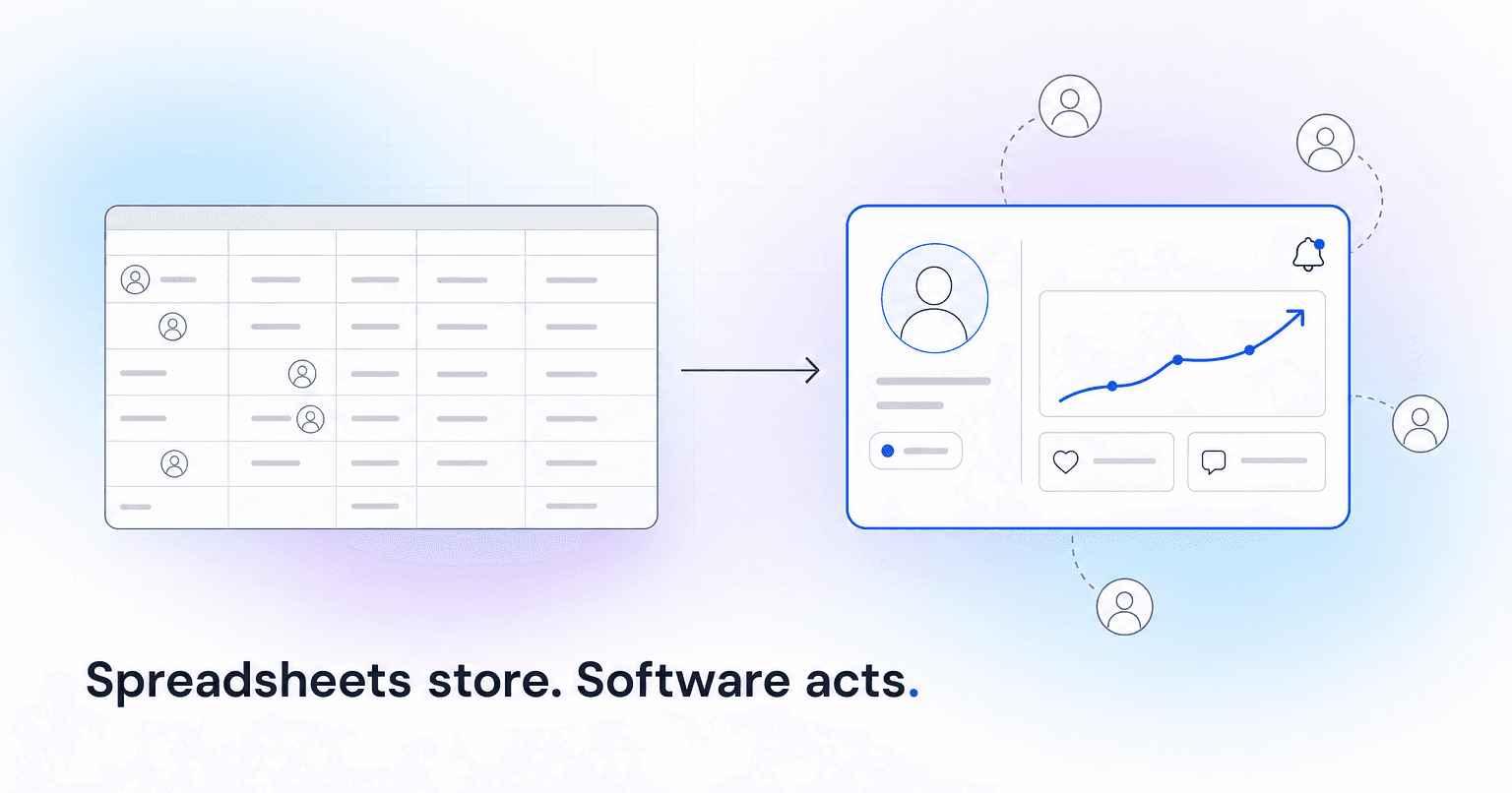
Google Sheets is a legitimate church database right up to the moment you need the data to do something back. Spreadsheets store. Software acts. If your entire need is "keep a list of names, phone numbers, and who signed up for the potluck," you do not need to pay anyone. The day someone asks "who used to be here every week and has quietly stopped coming?" and the only honest answer is "I'd have to go look," you have crossed the line where paid software starts earning its keep.
That line has nothing to do with attendance count. Plenty of 90-person churches should buy software and plenty of 300-person churches genuinely run fine on Sheets. It has to do with how many questions you are trying to ask of your data, and how many people need to answer them.
What spreadsheets actually do well
Give them their due. A shared Sheet is free, instantly familiar, and infinitely flexible. You can add a column at 9pm on a Saturday because a new ministry started. No vendor lock-in, no implementation call, no annual contract. For a directory, a rotating greeter schedule, an offering count sheet, or a one-off event RSVP list, a spreadsheet is often the right tool and switching to software is overkill.
Sheets also collaborate well. Three people can edit at once, version history is free, and anyone with a Gmail address already knows how to use it. That is a real advantage over software that requires training every new volunteer.
Where spreadsheets break, criterion by criterion
-
Cross-referencing. The core weakness. A single member record needs to answer four questions at the same time: when did they last show up, when did they last give, when did they last serve, when did they last respond to something you sent. In a spreadsheet world those four answers live in four different files, often owned by four different people, keyed by four slightly different spellings of the same name. VLOOKUP across "Mike Reynolds," "Michael Reynolds," and "M. Reynolds" fails silently, which is the worst kind of failing. Software enforces one record per person, which is unglamorous and the whole ballgame.
-
Noticing drift. A spreadsheet will never tell you anything. It waits to be asked. The families who leave a church rarely announce it; attendance thins from weekly to biweekly to monthly over four or five months, and nobody notices until Christmas. Engagement scoring and predictive analytics exist precisely to turn that slow drift into a short list of names before the person is gone.
-
Giving records and year-end statements. This is where most churches finally break. Contribution tracking in a spreadsheet means manual entry, manual reconciliation against the bank, and a January of mail-merging statements while praying the totals match. Software that ingests giving directly removes an entire annual crisis and gives your treasurer an audit trail. It is also usually where the "we thought giving was fine" conversation starts, because a spreadsheet shows you a total and hides the fact that eleven regular households stopped in the spring.
-
Privacy and access control. A Sheet shared by link is shared with everyone who has the link, forever, including the volunteer who left in 2023. Church databases hold home addresses, family relationships, financial patterns, and sometimes pastoral notes. Church member data privacy requires role-based access, meaning the nursery coordinator sees allergies but not giving history. Spreadsheets have no meaningful concept of that.
-
Continuity. The attendance file belongs to a person, not the church. When that volunteer burns out, the institutional memory leaves with the file structure only they understood.
What each option really costs
Compare honestly, with actual arithmetic. Small-church plans typically land somewhere between free and roughly $60 a month, and several vendors have genuinely usable free tiers if you only need one module (worth checking before you assume you must pay; see what Planning Center actually gives away). Call the paid case $720 a year.
Now price the spreadsheet. Three hours a week of someone reconciling attendance, chasing giving entries, and rebuilding the same report is about 150 hours a year. Value that person's time at $20 an hour and you are spending roughly $3,000 to avoid a $720 invoice. If those hours belong to your pastor rather than an admin, the number is worse, and it is being paid in Sunday-night energy instead of dollars. That is the trade most churches never actually write down. Automating the administrative layer is where the hours come back.
If you are staying on Sheets, at least harden it
Some churches genuinely should not buy anything yet. If that is you, three things will save you real pain later. Give every household a permanent ID number in a master roster and key every other sheet to that number instead of to a name. Share by named Google account, never by link, and audit the access list every January. And export a dated copy of the roster to a folder the church owns, not an individual, once a month. Do those and a future migration takes an afternoon instead of a summer.
So which should you pick?
Stay on Google Sheets if you have one person managing the data, under about 100 regular attenders, giving handled entirely by an outside platform that already issues statements, and no ambition to run systematic follow-up. Do not let anyone shame you out of a tool that works.
Buy software if any two of these are true: more than two people need to update member records, you are hand-building year-end contribution statements, you cannot name last month's five most-at-risk families without opening three files, or you are recruiting volunteers by asking the same tired people because you have no visibility into who else is ready. A solo admin running a few hundred people hits that threshold fast.
The upgrade worth making is not a nicer spreadsheet. It is a system that reads the signals and hands your team a call list on Tuesday morning. That is what ChurchAI is built to do on top of the data you already have, including data still sitting in Planning Center, Breeze, or CCB. If you are on the fence, spend one month logging how many hours the spreadsheet actually costs you. The number usually decides it.
Common questions
- What is ChurchAI?
- ChurchAI is an AI-native church management platform built to help churches retain members, grow giving, and eliminate administrative busywork. Unlike legacy church software that stores data passively, ChurchAI acts as an intelligence layer that connects to your existing tools, analyzes engagement patterns, predicts churn, identifies emerging donors and volunteer leaders, and automates follow-up workflows.
- How is ChurchAI different from Planning Center or other church management software?
- Most church management software like Planning Center, Rock CHMS, or Subsplash are built for administration and reporting. They store data but don't act on it. ChurchAI is built for discipleship and growth. It uses AI to proactively surface insights, predict which members are at risk of leaving, identify first-time and emerging givers, recommend volunteer candidates, and trigger automated follow-up communications. ChurchAI integrates with your existing tools and serves as the command center that turns church data into action.
- Does ChurchAI replace my current church software?
- No. ChurchAI connects directly with your existing church tools including Planning Center, Rock CHMS, Subsplash, Mailchimp, Microsoft Fabric, Power BI, and others. It acts as the intelligence layer on top of your current tech stack, unifying data from scattered systems into one command center without requiring you to switch platforms.
- What problems does ChurchAI solve for churches?
- ChurchAI solves three core problems: (1) Member churn — it identifies disengaged members early through attendance and engagement pattern analysis, then triggers automated follow-up before people fall through the cracks. (2) Missed growth opportunities — it surfaces emerging donors, first-time givers, and potential volunteer leaders that pastors would otherwise miss. (3) Administrative overload — it automates follow-ups, people management, growth tracks, and reporting so church staff can focus on ministry instead of spreadsheets.
- What size churches does ChurchAI work for?
- ChurchAI works for churches of all sizes, from growing congregations to enterprise-level megachurches with multiple campuses and complex tech stacks. The platform scales to handle multi-campus operations with thousands of members, multiple data systems, and sophisticated reporting needs.
- Is ChurchAI an AI chatbot for churches?
- No. ChurchAI is not a chatbot or a simple Q&A tool. It is a full AI-native platform with intelligent agents that analyze church data, score member engagement, predict behavior patterns, automate workflows, and deliver actionable insights. Think of it as an AI-powered Executive Pastor that monitors church health 24/7 and proactively surfaces what needs attention.
- What AI technology does ChurchAI use?
- ChurchAI uses AI-native architecture including large language models, engagement scoring models, predictive analytics for churn and giving patterns, and automated workflow agents. The platform's domain expertise is encoded directly into its AI workflows, prompts, and scoring models, built by founders with over a decade of church leadership experience. This creates a data flywheel where the more churches use ChurchAI, the smarter its predictions and recommendations become.
- How do I get started with ChurchAI?
- Visit churchai.com to request a demo. The ChurchAI team will walk you through the platform, understand your current tech stack and church needs, and show how ChurchAI integrates with your existing tools to deliver immediate value.