· 7 min read
Is There a Tool That Flags When a Church Member Stops Showing Up? A Primer for Small Churches
Lapse detection software flags members who go quiet by comparing recent attendance against each person's own baseline. Here's how it works, which tools do it, and why personal baselines beat blanket rules at 150 members.
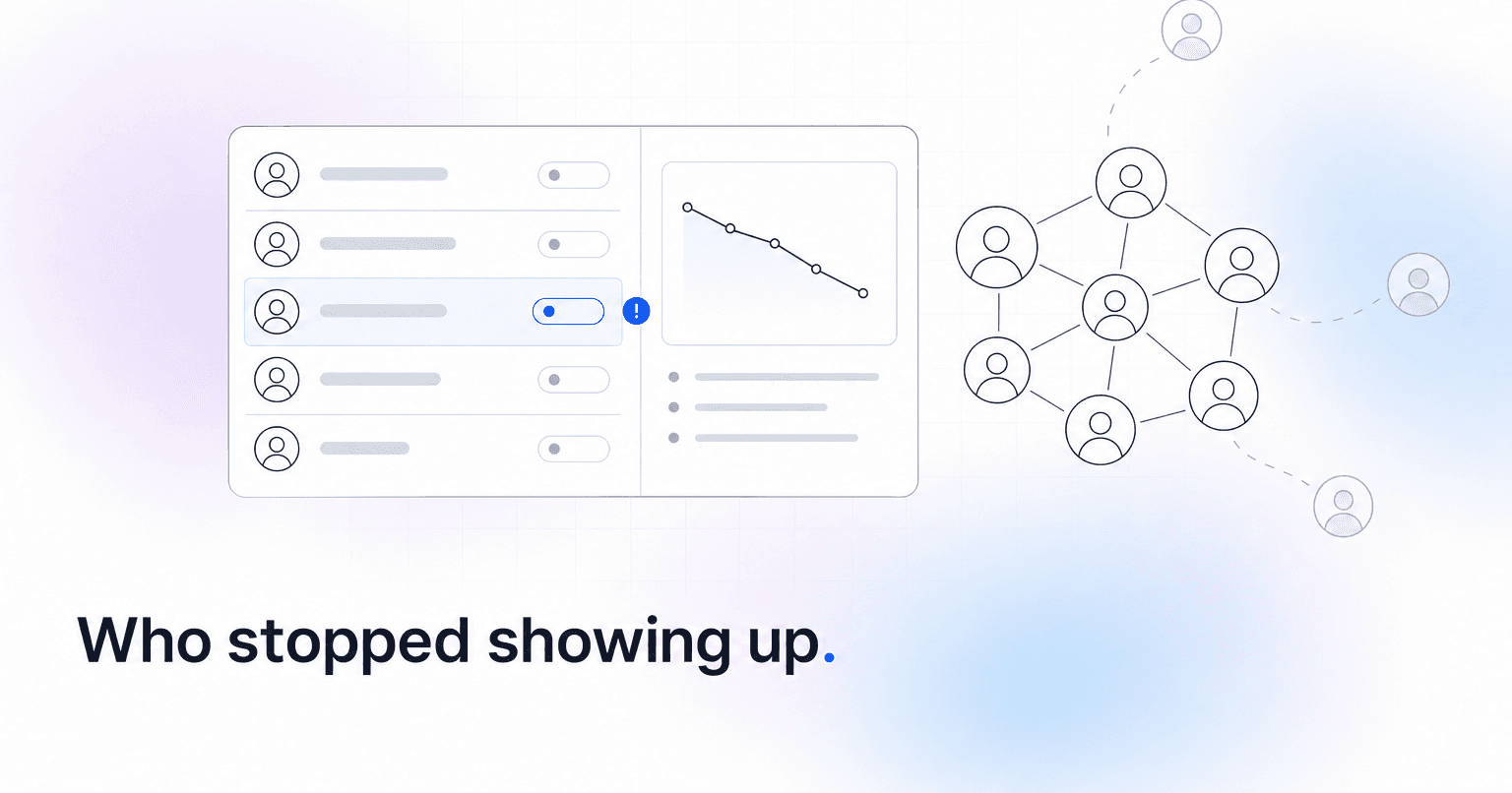
Yes. The feature is usually called lapsed attendance reporting or disengagement scoring, and most church management systems have some version of it, including Breeze, Planning Center, and ChurchTrac. It works by comparing each person's recent attendance against their own normal pattern and producing a list of names who have gone quiet. At 150 members, the software is the easy part. The hard part is capturing attendance by name every week and deciding who owns the phone call after a name appears.
Why quiet leaving is invisible at 150 members
A congregation of 150 loses people the way a bathtub loses water through a slow drain. Twelve people drifting out over a season is a row and a half of chairs. The room still looks full. Nobody on staff says "where is the Alvarez family," because the Alvarez family was never loud enough to leave a hole.
By the time someone notices, the honest gap is usually four to six months, and that gap matters. A member who has been away three weeks answers a text with "yeah, work has been brutal." A member who has been away five months answers with an apology, or does not answer at all. The window where a check-in feels like care rather than an audit is short.
What "lapse detection" actually means
Lapse detection is a rule or model that flags a person when their gap since last contact exceeds what is normal for them. Three pieces make it work:
- A dated record per person. Not a head count. A head count of 118 tells you nothing about who is missing.
- A baseline. How often does this specific member normally show up.
- A threshold. How far past baseline before the system raises a hand.
An engagement score is the same idea widened out: attendance plus giving, serving, group participation, and whether they open anything you send. Attendance is the loudest single signal, so it is the right place for a small church to start.
Why "missed three Sundays" is the wrong rule
Most churches set a blanket rule and get burned by it. Consider two people.
Dana has attended nearly every Sunday for six years. If Dana misses three in a row, something has changed, and the flag is correct.
Marcus has attended twice a month for two years, which is his steady normal. A "missed three consecutive Sundays" rule will never fire for Marcus, because he has never once attended three Sundays in a row. He can quietly leave and the system will stay silent forever.
Personal baselines fix this. Marcus gets flagged at roughly six weeks, when he has missed three of his own expected visits. Dana gets flagged at three. Same logic, different trigger. That distinction is the difference between a report you trust and one your staff learns to ignore. It is also the core of how predictive scoring works under the hood.
Getting attendance you can actually use
You cannot flag absence you never recorded. Choose one of these and be boring about it:
- Check-in kiosk or tablet at the door. Best accuracy, some friction, works well if you already check in children.
- Small group and serving team rolls. A group leader marking six names takes ten seconds and covers your most connected people.
- Staff sweep. One person with a tablet marking a member list after service. Crude, and at 150 people, entirely workable.
- Giving as a secondary signal. Not a substitute. It misses non-givers and lags by weeks.
Pick one method and hold it for eight weeks. A rough dataset kept consistently beats a perfect one kept for a month.
What tools do this, briefly
Breeze and ChurchTrac both let you pull a list of people with no attendance since a chosen date, which is a manual query you have to remember to run. Planning Center can do it through Check-Ins plus a saved list, with more setup. Comparisons of the tools built specifically for lapsed attendance reporting go deeper on the differences, and the roundup for small and mid-sized congregations is the closer fit at your size.
ChurchAI sits on top of the system you already use, builds the per-person baseline for you, and pushes the weekly list out instead of waiting to be asked. For a church without a data person, that push matters more than the math.
The flag is worthless without an owner
A list of names nobody calls is just a spreadsheet of regret. Before you turn anything on, decide two things: who reads the list each week, and what they send. Personal text, not a newsletter. Name the specific thing you miss about them. Ask nothing.
Three to eight names a week is what 150 members typically produce. That is one coffee and a handful of texts, a workload a volunteer elder can carry.
Expect a third of the list to be already gone
Nobody warns you about this part. The first time you run a lapse report on a congregation that has never had one, you get a backlog: people who left eighteen months ago, a family that moved to Arizona, someone who quietly joined the church across town. Reaching out feels awkward and some of those texts go unanswered.
Send them anyway, then close the record. Two reasons. A handful of those people were waiting to be asked and will tell you exactly why they stopped coming, which is intelligence you cannot buy. And clearing the backlog is what makes next month's list honest. A report showing four names you can act on beats one showing forty you cannot.
After that first cleanup, the weekly list stops being a guilt document and becomes a rhythm. Whoever owns it spends twenty minutes on a Tuesday. That is the whole system.
If you want to see what your own attendance data would flag, start there.
Common questions
- What is ChurchAI?
- ChurchAI is an AI-native church management platform built to help churches retain members, grow giving, and eliminate administrative busywork. Unlike legacy church software that stores data passively, ChurchAI acts as an intelligence layer that connects to your existing tools, analyzes engagement patterns, predicts churn, identifies emerging donors and volunteer leaders, and automates follow-up workflows.
- How is ChurchAI different from Planning Center or other church management software?
- Most church management software like Planning Center, Rock CHMS, or Subsplash are built for administration and reporting. They store data but don't act on it. ChurchAI is built for discipleship and growth. It uses AI to proactively surface insights, predict which members are at risk of leaving, identify first-time and emerging givers, recommend volunteer candidates, and trigger automated follow-up communications. ChurchAI integrates with your existing tools and serves as the command center that turns church data into action.
- Does ChurchAI replace my current church software?
- No. ChurchAI connects directly with your existing church tools including Planning Center, Rock CHMS, Subsplash, Mailchimp, Microsoft Fabric, Power BI, and others. It acts as the intelligence layer on top of your current tech stack, unifying data from scattered systems into one command center without requiring you to switch platforms.
- Can ChurchAI flag when a church member stops showing up?
- Yes. ChurchAI builds a per-person attendance baseline for every member and pushes a weekly lapsed-attendance report automatically—no manual query required. When someone's gap since last visit exceeds their own normal pattern, they appear on the list. This means a twice-a-month attender gets flagged at a different threshold than a weekly attender, so you catch quiet leavers that blanket "missed three Sundays" rules miss entirely.