· 5 min read
Second Campus or Second Service? What Engagement Data Changed About How We Make That Call
Add a service when your capacity problem is a room problem. Launch a campus when your capacity problem is a distance problem. Your engagement data tells you which one you actually have long before the parking lot does.
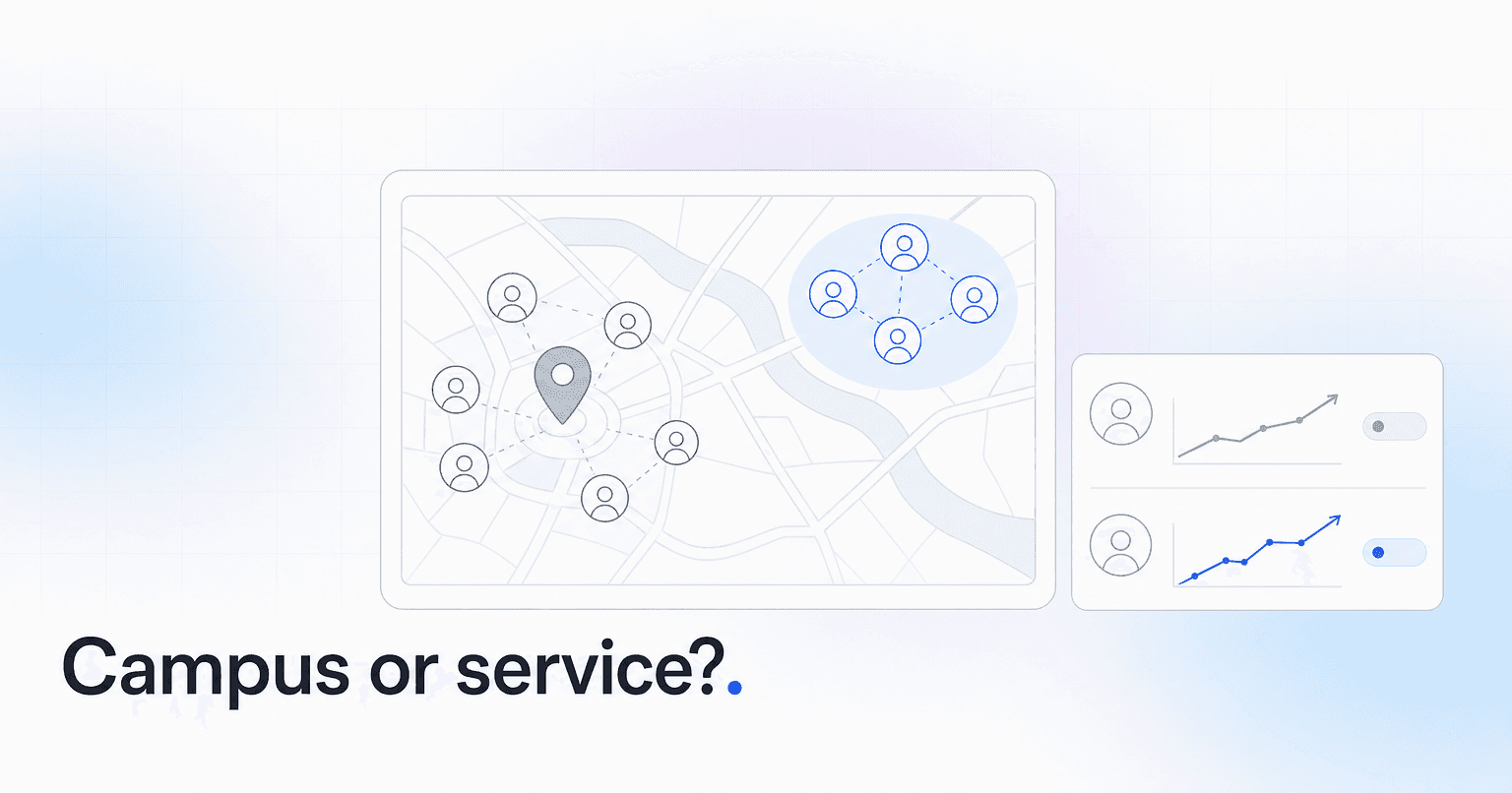
Add a service when your capacity problem is a room problem. Launch a campus when your capacity problem is a distance problem. That is the whole decision, and your engagement data tells you which one you actually have long before the parking lot does.
Most churches get this backwards because they measure the thing that is easiest to see. Seats are visible. Drive time, giving concentration by zip code, and what happens to a member's engagement score after they switch service times are not visible unless somebody goes looking.
How the call used to get made
For years the standard trigger was the 80% rule: when your auditorium is 80% full, you are functionally out of room, so do something. What that rule never answered was which something. So the tiebreaker became availability. Is there a school gym, a strip-mall lease, or a shuttered congregation willing to hand over a building? If yes, plant a campus. If no, add a 9:00am service and hope people move.
Two informal factors carried enormous weight too. Whether a staff member was ready to be a campus pastor. And whether the elder board found multi-site exciting. Neither is a bad input. Both are terrible primary inputs, because they describe the supply of a launch rather than the demand for one.
Here is the part that gets underweighted: the cost of being wrong is wildly asymmetric. A third service nobody attends costs you a worship team's Sunday morning and some volunteer fatigue. You can kill it in six months with minimal scarring, and most people will not remember it happened. A campus that underperforms costs a lease, a salary, a meaningful slice of your most committed volunteers, and a public retreat if you close it. Churches rarely close them. They quietly subsidize them for years instead, and the subsidy comes out of the sending campus.
What the data actually shows
None of the reads below require a new software category. They require a unified member record that ties attendance, giving, groups, and serving to one person, so you can slice the same congregation three different ways.
Geographic concentration of engaged households, not total attendance. Map giving households and group members by zip code, not just check-ins. A campus is justified when a dense cluster of already engaged people sits twenty-plus minutes away, because those are the people who will carry a launch through its ugly first year. A cluster of low-engagement attenders twenty minutes away is not a campus. It is a follow-up problem wearing a campus costume, and a building will not fix it.
Retention after a service-time change. Pull every member who switched service times in the last two years and track their engagement score for the following six months. If people who moved from 11:00 to 9:00 held steady, your congregation is time-flexible and a new service will absorb growth cheaply. If their attendance frequency sagged after the move, adding a service will mostly shuffle your existing crowd into a thinner room and you will have solved nothing while paying for two of everything. Engagement scoring is what makes this measurable instead of anecdotal.
Sending-campus drawdown. Before launch, name the specific households going with the campus pastor and total their giving, their volunteer hours, and their group leadership roles. The pattern we see over and over is that launch teams pull a modest share of attendance and a much larger share of serving capacity, because the people who sign up for a plant are the people who were already signed up for everything else.
Work it on a real roster. Say you run 900 across two services, with about 130 people covering kids, hospitality, tech, and worship. Your launch team is 110 people, roughly 12% of attendance, which sounds survivable. Then you check the names and 34 of them are in that 130. You just cut your volunteer bench by a quarter to move 12% of your crowd. That is how you end up with two fragile sites instead of one healthy one, and you will feel it in the kids wing by week three.
What we do now
The sequence is boring on purpose. Geography read first. If there is no engaged cluster past a twenty-minute drive, the answer is a service, full stop, no matter how attractive the building is or how ready the campus pastor feels. If there is a cluster, run the drawdown math and confirm the sending campus survives it on paper before anyone signs anything. Leadership and lease come last, not first.
After launch, measure per-campus retention separately for at least four quarters. A campus that grows attendance while its giving-per-household and group participation trail the original site is not growing. It is collecting attenders, and that gap widens quietly. Rolling both sites into one dashboard is how you catch it in quarter two rather than year two, which is why multi-campus reporting is worth solving before the launch rather than after.
The lesson
Capacity is a symptom, not a diagnosis. The real question is whether your growth is constrained by when people can come or where they have to drive, and those need opposite answers. The evidence is already sitting in your records. Predictive engagement analysis in ChurchAI reads the same signals it uses to flag a drifting member, pointed at a launch decision instead: who is engaged, where they live, and what happens to them after something changes.
Decide it with the data you have. The building will still be there next quarter.
Common questions
- What is ChurchAI?
- ChurchAI is an AI-native church management platform built to help churches retain members, grow giving, and eliminate administrative busywork. Unlike legacy church software that stores data passively, ChurchAI acts as an intelligence layer that connects to your existing tools, analyzes engagement patterns, predicts churn, identifies emerging donors and volunteer leaders, and automates follow-up workflows.
- How is ChurchAI different from Planning Center or other church management software?
- Most church management software like Planning Center, Rock CHMS, or Subsplash are built for administration and reporting. They store data but don't act on it. ChurchAI is built for discipleship and growth. It uses AI to proactively surface insights, predict which members are at risk of leaving, identify first-time and emerging givers, recommend volunteer candidates, and trigger automated follow-up communications. ChurchAI integrates with your existing tools and serves as the command center that turns church data into action.
- Does ChurchAI replace my current church software?
- No. ChurchAI connects directly with your existing church tools including Planning Center, Rock CHMS, Subsplash, Mailchimp, Microsoft Fabric, Power BI, and others. It acts as the intelligence layer on top of your current tech stack, unifying data from scattered systems into one command center without requiring you to switch platforms.
- What problems does ChurchAI solve for churches?
- ChurchAI solves three core problems: (1) Member churn — it identifies disengaged members early through attendance and engagement pattern analysis, then triggers automated follow-up before people fall through the cracks. (2) Missed growth opportunities — it surfaces emerging donors, first-time givers, and potential volunteer leaders that pastors would otherwise miss. (3) Administrative overload — it automates follow-ups, people management, growth tracks, and reporting so church staff can focus on ministry instead of spreadsheets.
- What size churches does ChurchAI work for?
- ChurchAI works for churches of all sizes, from growing congregations to enterprise-level megachurches with multiple campuses and complex tech stacks. The platform scales to handle multi-campus operations with thousands of members, multiple data systems, and sophisticated reporting needs.
- Is ChurchAI an AI chatbot for churches?
- No. ChurchAI is not a chatbot or a simple Q&A tool. It is a full AI-native platform with intelligent agents that analyze church data, score member engagement, predict behavior patterns, automate workflows, and deliver actionable insights. Think of it as an AI-powered Executive Pastor that monitors church health 24/7 and proactively surfaces what needs attention.
- What AI technology does ChurchAI use?
- ChurchAI uses AI-native architecture including large language models, engagement scoring models, predictive analytics for churn and giving patterns, and automated workflow agents. The platform's domain expertise is encoded directly into its AI workflows, prompts, and scoring models, built by founders with over a decade of church leadership experience. This creates a data flywheel where the more churches use ChurchAI, the smarter its predictions and recommendations become.
- How do I get started with ChurchAI?
- Visit churchai.com to request a demo. The ChurchAI team will walk you through the platform, understand your current tech stack and church needs, and show how ChurchAI integrates with your existing tools to deliver immediate value.