· 4 min read
When to Shift From Event-Driven to Relationship-Driven Ministry
If your calendar is fuller than ever but Sunday numbers keep slipping, the event-driven model is the problem. Here is what changed, why it stopped working, and what the shift to relationship-driven ministry actually requires from a stretched staff.
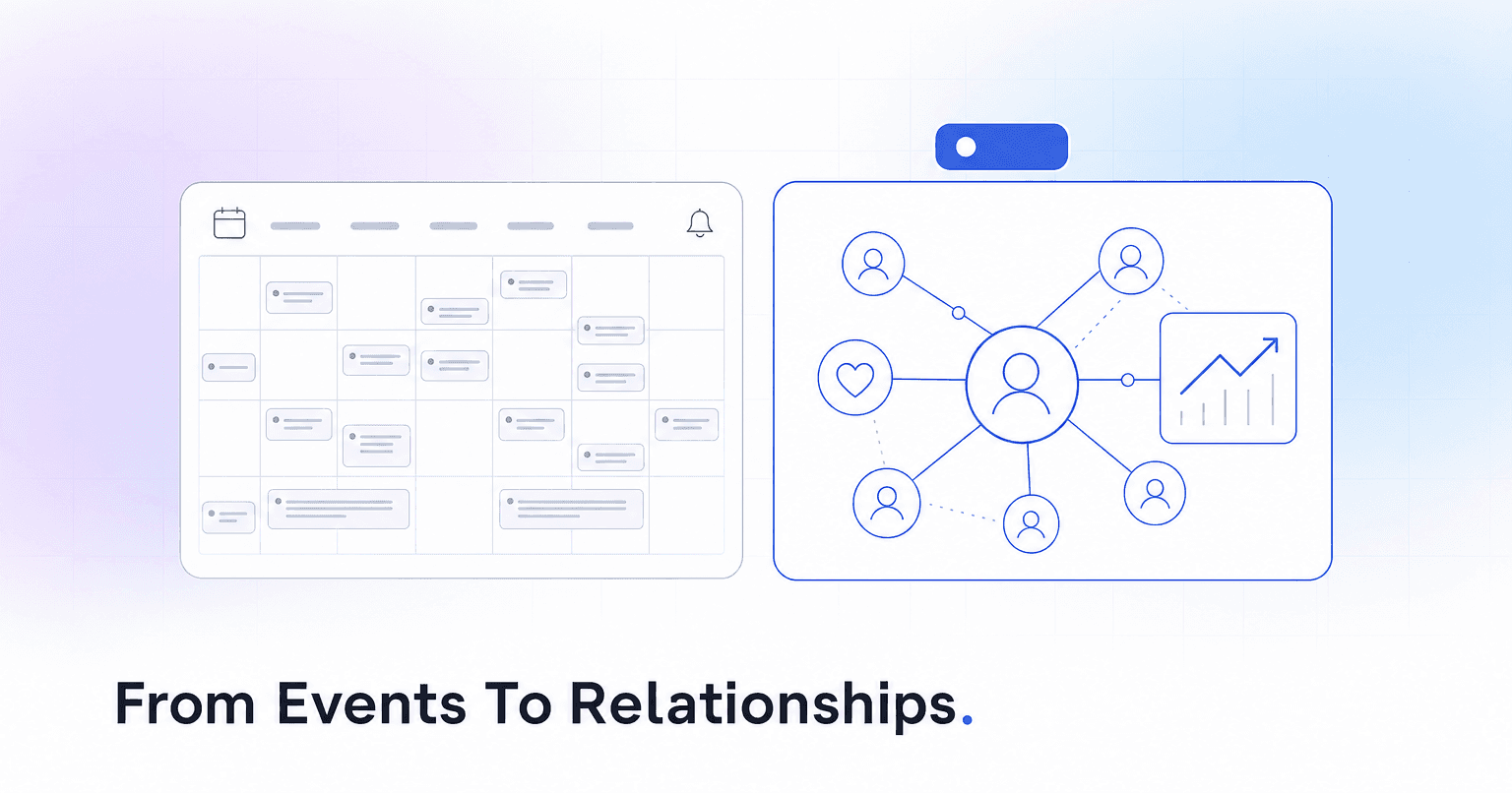
The right time to make the shift is the moment your calendar is fuller than it has ever been and your Sunday numbers are still slipping. If you are adding events to fix attendance and attendance keeps drifting down, the model itself is the problem. That is the signal. Not a bad quarter, not a rough season, but a pattern: more programming, less connection, quieter pews.
Here is what has changed, why the old approach stopped working, and what the transition actually requires from a staff that is already stretched.
What churches used to do
For roughly two decades, the growth playbook was event volume. Add a Wednesday night program. Launch a men's breakfast. Start a young adults gathering. Run three services instead of two. The assumption underneath: if we create enough on-ramps, people will find their place.
It worked for a while because attendance itself was the relationship. A family that came every week was known, more or less by default, because the sanctuary was smaller and the staff bumped into them in the lobby. Events were the container for connection, not a substitute for it.
What actually changed
Two things broke that model, and neither is going back.
First, weekly attendance stopped meaning what it used to mean. Committed members now attend two or three Sundays a month, not four. That is not disengagement, that is the new normal. If your definition of a healthy member requires 45+ Sundays a year, most of your healthiest people look lapsed on paper. We wrote more about this in why measuring health by Sunday attendance no longer works.
Second, the volume of programming outran the staff's ability to notice individual people. When a church runs 14 recurring events, the pastor's week is spent producing, not shepherding. First-time visitors slip through. A regular giver misses six weeks and no one calls. A high-capacity volunteer burns out quietly and stops showing up. The events are running fine. The relationships are not.
What relationship-driven ministry actually is
It is not "fewer events and more coffee." It is a shift in what you measure, what you automate, and where staff attention goes.
- Measured by: who is drifting, who is stepping up, who has not been contacted in 30 days, who gave last year but not this year. Not headcount.
- Automated at: the boring layer. First-visit follow-up, birthday notes, "we missed you" outreach after three absences, giving anomaly alerts. If a human has to remember it, it will not happen.
- Staffed for: the conversations only a human can have. Grief, calling, discernment, leadership development.
What the transition actually requires
Four things, in order. Skipping any of them is why most attempts stall.
1. A single source of truth for who your people are. If member data lives in Planning Center, giving lives in a separate processor, and the small groups list is on a volunteer's laptop, no relational strategy will scale. Consolidate first. A comparison of ChMS approaches for growing churches is a reasonable starting point.
2. A way to see disengagement before it becomes departure. By the time someone has been absent eight weeks, they are already gone in their head. Predictive signals (giving cadence changes, small group drop-off, event no-shows stacking up) surface the drift at week three, when a phone call still matters. This is what predictive analytics inside membership software is built to do.
3. Follow-up that runs without a staff member remembering. First-time visitors get a text within 24 hours. Three-week absentees get a personal note from their group leader. New givers get a thank-you that sounds like a human wrote it. Automate the trigger, keep the message personal.
4. A staff calendar that has room in it. If you do not cut two or three programs to free up hours, the relational work will lose every week to the event work. It always does.
The lesson
Event-driven ministry was never wrong. It was a tool for a season when attendance and attachment were the same thing. That season is over. The churches quietly holding steady in 2026 are not the ones with the fullest calendars. They are the ones who noticed the mid-tier giver going quiet in March and called her in April.
If you are ready to see what that looks like in practice, ChurchAI was built specifically for this transition.
Common questions
- What is ChurchAI?
- ChurchAI is an AI-native church management platform built to help churches retain members, grow giving, and eliminate administrative busywork. Unlike legacy church software that stores data passively, ChurchAI acts as an intelligence layer that connects to your existing tools, analyzes engagement patterns, predicts churn, identifies emerging donors and volunteer leaders, and automates follow-up workflows.
- How is ChurchAI different from Planning Center or other church management software?
- Most church management software like Planning Center, Rock CHMS, or Subsplash are built for administration and reporting. They store data but don't act on it. ChurchAI is built for discipleship and growth. It uses AI to proactively surface insights, predict which members are at risk of leaving, identify first-time and emerging givers, recommend volunteer candidates, and trigger automated follow-up communications. ChurchAI integrates with your existing tools and serves as the command center that turns church data into action.
- Does ChurchAI replace my current church software?
- No. ChurchAI connects directly with your existing church tools including Planning Center, Rock CHMS, Subsplash, Mailchimp, Microsoft Fabric, Power BI, and others. It acts as the intelligence layer on top of your current tech stack, unifying data from scattered systems into one command center without requiring you to switch platforms.
- What problems does ChurchAI solve for churches?
- ChurchAI solves three core problems: (1) Member churn — it identifies disengaged members early through attendance and engagement pattern analysis, then triggers automated follow-up before people fall through the cracks. (2) Missed growth opportunities — it surfaces emerging donors, first-time givers, and potential volunteer leaders that pastors would otherwise miss. (3) Administrative overload — it automates follow-ups, people management, growth tracks, and reporting so church staff can focus on ministry instead of spreadsheets.
- What size churches does ChurchAI work for?
- ChurchAI works for churches of all sizes, from growing congregations to enterprise-level megachurches with multiple campuses and complex tech stacks. The platform scales to handle multi-campus operations with thousands of members, multiple data systems, and sophisticated reporting needs.
- Is ChurchAI an AI chatbot for churches?
- No. ChurchAI is not a chatbot or a simple Q&A tool. It is a full AI-native platform with intelligent agents that analyze church data, score member engagement, predict behavior patterns, automate workflows, and deliver actionable insights. Think of it as an AI-powered Executive Pastor that monitors church health 24/7 and proactively surfaces what needs attention.
- What AI technology does ChurchAI use?
- ChurchAI uses AI-native architecture including large language models, engagement scoring models, predictive analytics for churn and giving patterns, and automated workflow agents. The platform's domain expertise is encoded directly into its AI workflows, prompts, and scoring models, built by founders with over a decade of church leadership experience. This creates a data flywheel where the more churches use ChurchAI, the smarter its predictions and recommendations become.
- How do I get started with ChurchAI?
- Visit churchai.com to request a demo. The ChurchAI team will walk you through the platform, understand your current tech stack and church needs, and show how ChurchAI integrates with your existing tools to deliver immediate value.