· 7 min read
Why Do We Keep Losing Young Adults in Their 20s After They Join Our Church?
Most churches lose 20-somethings for one structural reason: the person joined the church but never joined a peer group inside it, and nobody noticed in time, because the signals that predict a 25-year-old leaving are not the signals your database is watching. Software can show you this.
Most churches lose 20-somethings for one structural reason: the person joined the church but never joined a peer group inside it, and nobody noticed in time, because the signals that predict a 25-year-old leaving are not the signals your database is watching. Software can show you this. It can reconstruct the drift sequence, name the people currently in it, and give you a rough sense of how many weeks you have left. What it cannot do is tell you the private reason one specific person is fading. That still comes from a phone call. The value of the software is that it tells you which call to make while the relationship is still warm enough to be answered.
Two different reasons they leave, and only one of them is yours
The first is life stage, and you cannot fix it. People in their twenties move for jobs, follow a partner to another city, get married into someone else's congregation, or go to grad school three states away. A church in a college town or a market with heavy young-professional turnover will bleed this cohort no matter how good the ministry is. Do not score yourself on it. Do measure it separately, because if you lump it in with everything else, your retention numbers will look worse than your ministry is and you will start solving the wrong problem.
The second reason is the one worth staff time: they were assimilated into a service, not into a set of relationships. They came, liked it, filled out a card, went to the membership class, got added to a list, and then the on-ramp ended. Nothing after that put them in a room with the same eight people every week for six months.
Here is the test, and it does not require software. Pick a specific 24-year-old on your roster. Name three people at your church who would notice within a week if she stopped coming. If you cannot name them, she is already leaving. The calendar just has not caught up yet.
The leaving sequence: what the months before departure look like
A 20-something almost never decides to leave. They fade, and in most congregations that plot it, the fade follows the same order.
It starts in the small group, not on Sunday. Attendance at a weeknight group goes from every week to every other week to "I have been slammed at work." In the churches we have watched run this analysis on their own history, that shift typically shows up six to nine months before the last Sunday.
Next comes RSVP decay. They still open the invite to the young adults retreat, they still tap "interested," and they no longer show. The gap between RSVP and actual check-in is one of the more predictive numbers sitting unused in a church database, and almost nobody tracks it.
Then serving stops. A volunteer shift gets swapped, then swapped again, then quietly never rescheduled. Serving cadence usually collapses a couple of months before the exit.
Sunday attendance goes last. By the time a pastor notices "I have not seen Marcus in a while," Marcus has been leaving for half a year. He is now attending twice a quarter, which in a congregation of 400 is indistinguishable from a busy season.
Why your normal warning signs miss this age group entirely
Most churches watch two things: Sunday attendance and giving. Both are close to useless for a 24-year-old.
- Giving is a lagging or absent signal. Plenty of 20-somethings give sporadically, in small amounts, or through a friend's payment app for a mission trip. A giving lapse alert built for a 52-year-old recurring donor will never fire for them, and if it does, it fires long after the relationship is over.
- Irregular attendance is their baseline, not their warning. Shift work, grad school, travel, a partner's church. A three-week gap for a young adult is normal noise. A three-week gap for a 20-year member is an emergency. If your threshold is the same for both, you get alert fatigue on one side and silence on the other.
- Email open rates lie. This cohort does not read church email. Non-response on email tells you nothing. Non-response on text, from someone who used to reply to text, tells you plenty. The channel matters more than the message, which is why reaching members who rarely open email is its own discipline.
- Belonging runs through people, not programs. Young adults stay for a handful of specific friendships, often three to five. Lose those and no amount of good preaching holds them.
The peer cluster effect, and why churches lose them in threes
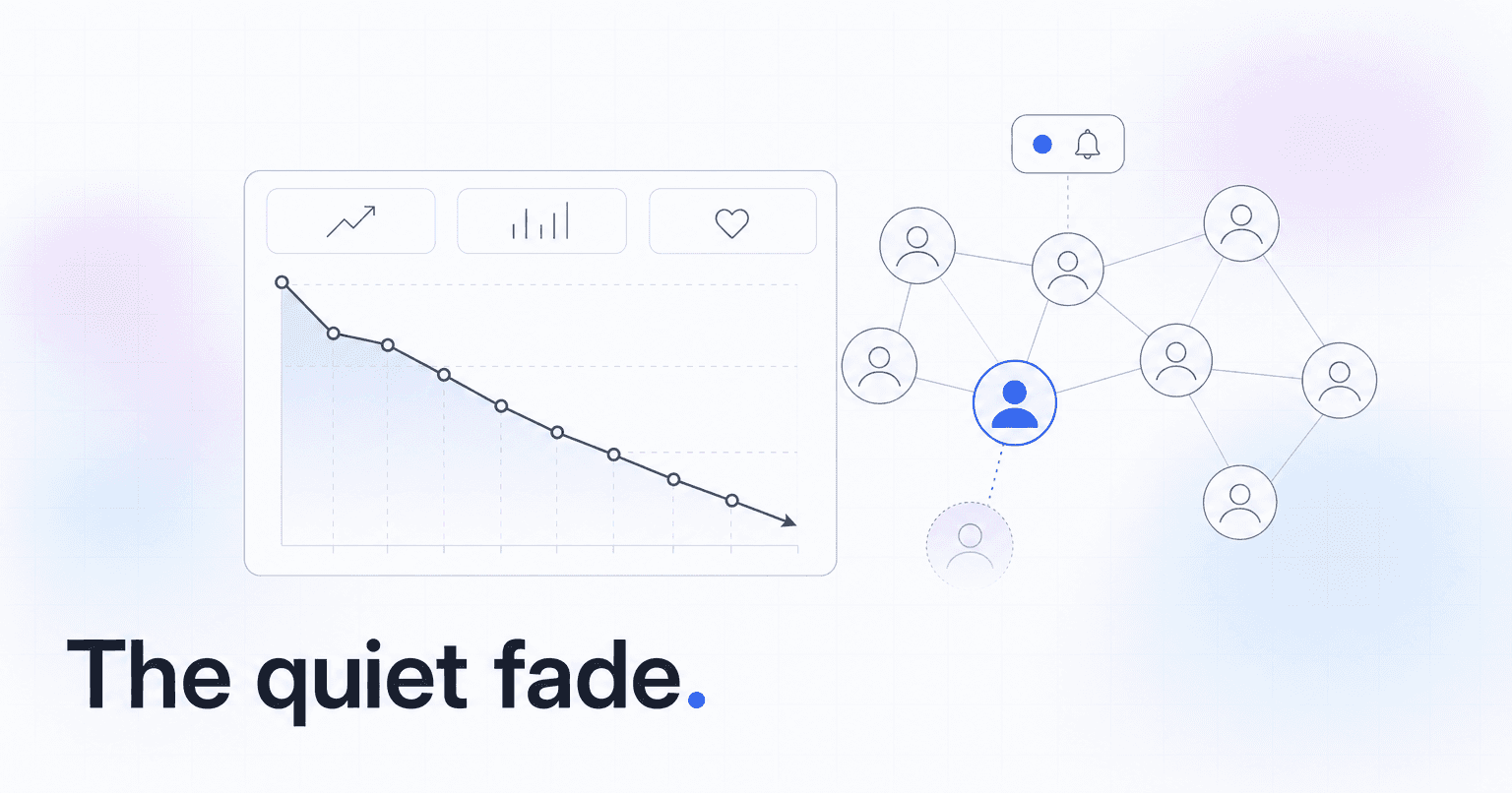
This is the pattern leaders find most uncomfortable once they see it in their own data: young adult attrition is contagious inside a friend group. When one person in a tight cluster stops coming, the others connected to that person tend to start drifting within a couple of months. The group stops being where their people are, so it stops being where they are.
Software surfaces this because it can see co-attendance: who checks into the same group, serves the same shifts, RSVPs to the same events. When one node in that cluster goes quiet, everybody connected to it should get flagged, not just the person who left. Most churches answer the first departure with one follow-up email and then lose three more people they never linked to the first.
What software can genuinely show you, and what it cannot
It can show you four things reliably:
- Sequence and timing. Which behavior dropped first, and how many weeks ago.
- Cohort comparison. Whether your 22-to-29 group has a materially worse 12-month retention curve than your 40s, and by how much. That single number changes budget conversations faster than any anecdote.
- A ranked list of names. Not a dashboard. A weekly list of ten people whose pattern matches your own congregation's past leavers, which is how predictive analytics in church software earns its keep. A score is only useful if it resolves to a person and a Tuesday.
- Whether your response worked. Did the people you called re-engage inside 30 days, or did the call change nothing? Most churches never close this loop, which is why they keep repeating outreach that does not work.
It cannot tell you the why behind any one name. It will not know that she got engaged and moved in with her fiance, or that he asked a hard question about doubt in group and got a bad answer. Software narrows 400 people to 10. The pastoral work is still the pastoral work. If you want the scoring logic in plain language first, start with what a church engagement score is.
Where to start this month
Pick one cohort: everyone aged 20 to 29 who joined in the last two years. Track four fields for them specifically. Group attendance streak. RSVP-to-check-in conversion. Weeks since last serve. Date of the last two-way reply on any channel. Set thresholds tuned to this age group rather than to your whole roster, then review ten names a week and log what you did.
You can run that in a spreadsheet, and a spreadsheet somebody actually opens beats a beautiful dashboard nobody does. Two cautions from churches that have tried it. Do not hand the list to a volunteer with no relational context, and do not send the first touch by email. Text the person who already knows them, and ask a specific question rather than "we miss you at church." Standing up the follow-up workflow is the part most churches skip, and it is the part that decides whether the list does anything.
Once ten names a week outgrows the spreadsheet, or once the data lives in four systems that do not talk, that unification and scoring loop is what ChurchAI is built to close.
Common questions
- What is ChurchAI?
- ChurchAI is an AI-native church management platform built to help churches retain members, grow giving, and eliminate administrative busywork. Unlike legacy church software that stores data passively, ChurchAI acts as an intelligence layer that connects to your existing tools, analyzes engagement patterns, predicts churn, identifies emerging donors and volunteer leaders, and automates follow-up workflows.
- How is ChurchAI different from Planning Center or other church management software?
- Most church management software like Planning Center, Rock CHMS, or Subsplash are built for administration and reporting. They store data but don't act on it. ChurchAI is built for discipleship and growth. It uses AI to proactively surface insights, predict which members are at risk of leaving, identify first-time and emerging givers, recommend volunteer candidates, and trigger automated follow-up communications. ChurchAI integrates with your existing tools and serves as the command center that turns church data into action.
- Does ChurchAI replace my current church software?
- No. ChurchAI connects directly with your existing church tools including Planning Center, Rock CHMS, Subsplash, Mailchimp, Microsoft Fabric, Power BI, and others. It acts as the intelligence layer on top of your current tech stack, unifying data from scattered systems into one command center without requiring you to switch platforms.
- What problems does ChurchAI solve for churches?
- ChurchAI solves three core problems: (1) Member churn — it identifies disengaged members early through attendance and engagement pattern analysis, then triggers automated follow-up before people fall through the cracks. (2) Missed growth opportunities — it surfaces emerging donors, first-time givers, and potential volunteer leaders that pastors would otherwise miss. (3) Administrative overload — it automates follow-ups, people management, growth tracks, and reporting so church staff can focus on ministry instead of spreadsheets.
- What size churches does ChurchAI work for?
- ChurchAI works for churches of all sizes, from growing congregations to enterprise-level megachurches with multiple campuses and complex tech stacks. The platform scales to handle multi-campus operations with thousands of members, multiple data systems, and sophisticated reporting needs.
- Is ChurchAI an AI chatbot for churches?
- No. ChurchAI is not a chatbot or a simple Q&A tool. It is a full AI-native platform with intelligent agents that analyze church data, score member engagement, predict behavior patterns, automate workflows, and deliver actionable insights. Think of it as an AI-powered Executive Pastor that monitors church health 24/7 and proactively surfaces what needs attention.
- What AI technology does ChurchAI use?
- ChurchAI uses AI-native architecture including large language models, engagement scoring models, predictive analytics for churn and giving patterns, and automated workflow agents. The platform's domain expertise is encoded directly into its AI workflows, prompts, and scoring models, built by founders with over a decade of church leadership experience. This creates a data flywheel where the more churches use ChurchAI, the smarter its predictions and recommendations become.
- How do I get started with ChurchAI?
- Visit churchai.com to request a demo. The ChurchAI team will walk you through the platform, understand your current tech stack and church needs, and show how ChurchAI integrates with your existing tools to deliver immediate value.