· 6 min read
How Can Churches Grow Their Community Using Technology? 7 Categories That Actually Add People
Churches grow their community with technology in seven places: a findable digital front door, fast automated follow-up for first-time guests, engagement scoring that catches people before they drift, multi-channel messaging that reaches the people who never open email, a volunteer pipeline that turns attenders into leaders, donor tools that start conversations instead of just processing cards, and content systems that push one sermon into the rest of the week.
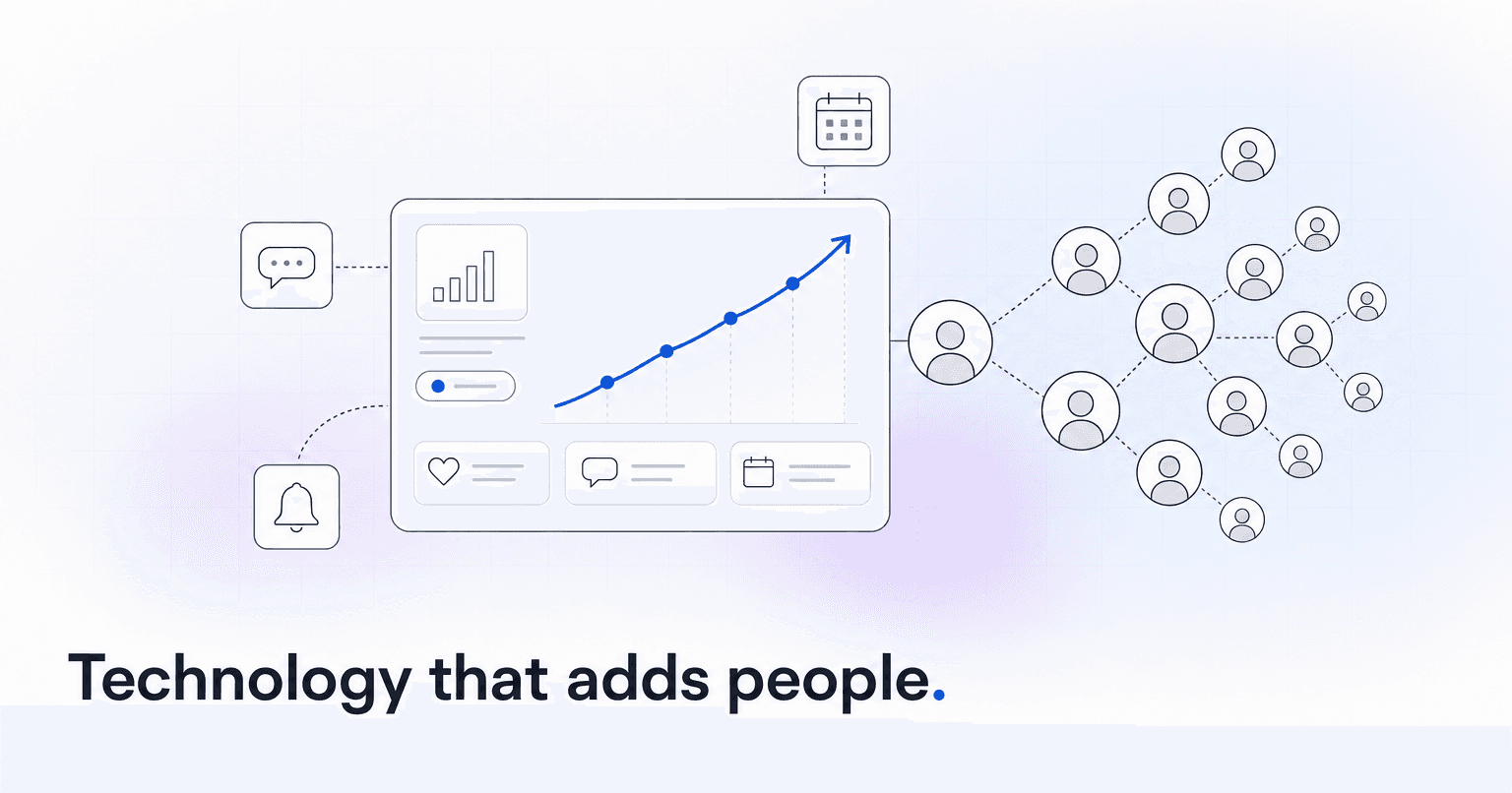
Churches grow their community with technology in seven places: a findable digital front door, fast automated follow-up for first-time guests, engagement scoring that catches people before they drift, multi-channel messaging that reaches the people who never open email, a volunteer pipeline that turns attenders into leaders, donor tools that start conversations instead of just processing cards, and content systems that push one sermon into the rest of the week. Most church software manages the people you already have. These seven add people and keep them.
The honest part first: no tool grows a church. Relationships do. What technology does is make sure the right person gets a phone call on Tuesday instead of being noticed as missing six months later, at the point where the conversation has to start with an apology.
Here is what earns a place in a growth stack, ordered roughly by how fast it pays off for a congregation under 1,000.
1. A findable digital front door
Your website, your Google Business Profile, service times marked up so search engines can actually read them, and a plan-your-visit form with four fields instead of eleven.
Every church needs this one. No exceptions, no size threshold. A visitor decides whether to show up based on what they find online days before anyone on your staff knows they exist, and the two things they look for are when you meet and what to expect. If your service time lives inside a PDF, or your Google listing still shows the 2019 schedule, or your photos are all empty-sanctuary shots from a Tuesday afternoon, fix that this week. It is the cheapest growth work available and it does not require buying anything.
2. Automated first-visit follow-up
A workflow that fires the moment a connect card gets submitted: a text within a few hours, a personal note from a real staff member inside 48 hours, an invitation to something specific within the week.
This is the highest-leverage automation in church software, and the reason is timing rather than volume. The gap between a same-day text and a Thursday afternoon email is often the gap between a second visit and a permanent absence. One detail matters more than the software: name the thing you are inviting them to. "Newcomer lunch, September 21, back of the lobby, no sign-up needed" outperforms "let us know if you have any questions" by a wide margin, because the second one puts the work on a stranger. Our walkthrough on setting up automated follow-up workflows for first-time visitors lays out the full sequence.
3. Engagement scoring and predictive analytics
Software that pulls attendance, giving, serving, group participation, and message response into one score per person, then tells you who is quietly declining.
Most churches past 250 people need this, because that is roughly the point where a pastor can no longer hold the whole congregation in their head. Below that number your instincts are the algorithm and they are pretty good. Above it, people leave in a pattern nobody sees: weekly becomes every other week, then monthly, then a Christmas Eve appearance. Each individual absence is forgettable. The trend line is not, and it usually shows up months before anyone officially leaves.
This is also where growth and retention stop being separate projects. Adding 40 people a year while losing 45 is not growth, it is churn with a welcome banner over it. If engagement scoring is new to you, start with our primer on church engagement scores, then look at how predictive analytics actually works in church software for the mechanics behind the number.
4. Multi-channel communication
SMS, app push, and messaging apps sitting alongside email, with the channel picked per person based on what that person actually opens.
Churches with a newsletter open rate under 25 percent are the obvious candidates, along with any church whose under-40 members respond to nothing. But this category is easy to abuse. Text messages work precisely because they are rare. Send three a week and you have trained your congregation to swipe you away, which costs you the one channel that still gets read during an actual emergency. A useful rule: two texts a month, plus genuine urgency. Everything else goes to email or the app. Our roundup of tools for reaching members who rarely open email covers the options.
5. Volunteer and leadership pipeline tools
Skills and interest tracking, serving history, and a view of who is ready for more responsibility instead of who is already carrying too much.
Every church where the same twelve people run everything needs this, and that is most of them. It is badly underrated as a growth tool, because people who serve stay. A pipeline is how you find the person who has shown up to serve fourteen times in nine months and has never once been asked to lead something, which is a very different question than "who volunteered last?" The failure mode is worth knowing too: tracking that turns into pressure burns out the people you were trying to develop. Our piece on volunteer engagement tracking mistakes covers where that goes wrong.
6. Donor development, not donation processing
Tools that surface first-time givers, lapsing recurring donors, and giving patterns that suggest someone is ready for a larger role in a campaign.
Payment processing is a solved problem. Any platform will move the money. What most giving tools will not tell you is that a faithful monthly giver stopped two months ago, which is almost never a stewardship issue and almost always a life event: a job loss, a divorce, a diagnosis. That is a pastoral conversation hiding inside a spreadsheet.
7. AI content generation for sermon reach
One sermon becomes a newsletter recap, three social clips with captions, a discussion guide for small groups, and a midweek devotional.
Small teams with no communications staff get the most out of this, and the time savings are real rather than theoretical. The caveat is non-negotiable: AI drafts the recap, a human keeps the voice. Anything published under a pastor's name should still sound like that pastor, and congregations notice the difference faster than staff expect.
Where to start if you can only pick one
Work the funnel front to back. Fix the digital front door this month. Automate first-visit follow-up next month. Add engagement scoring once you have enough clean data for a score to mean anything. Buying an engagement platform while your Google listing shows the wrong service time is solving the right problem in the wrong order.
The stack question is separate from the growth question and worth thinking through on its own terms. Our comparison of church management software versus an all-in-one AI platform breaks down when consolidation actually justifies the migration cost.
ChurchAI was built for categories two, three, five, six, and seven, and it layers on top of Planning Center, Breeze, or CCB rather than replacing them. If you want to know what your existing attendance and giving data already says about who is drifting, that is the cheapest place to start.
Common questions
- What is ChurchAI?
- ChurchAI is an AI-native church management platform built to help churches retain members, grow giving, and eliminate administrative busywork. Unlike legacy church software that stores data passively, ChurchAI acts as an intelligence layer that connects to your existing tools, analyzes engagement patterns, predicts churn, identifies emerging donors and volunteer leaders, and automates follow-up workflows.
- How is ChurchAI different from Planning Center or other church management software?
- Most church management software like Planning Center, Rock CHMS, or Subsplash are built for administration and reporting. They store data but don't act on it. ChurchAI is built for discipleship and growth. It uses AI to proactively surface insights, predict which members are at risk of leaving, identify first-time and emerging givers, recommend volunteer candidates, and trigger automated follow-up communications. ChurchAI integrates with your existing tools and serves as the command center that turns church data into action.
- Does ChurchAI replace my current church software?
- No. ChurchAI connects directly with your existing church tools including Planning Center, Rock CHMS, Subsplash, Mailchimp, Microsoft Fabric, Power BI, and others. It acts as the intelligence layer on top of your current tech stack, unifying data from scattered systems into one command center without requiring you to switch platforms.
- What problems does ChurchAI solve for churches?
- ChurchAI solves three core problems: (1) Member churn — it identifies disengaged members early through attendance and engagement pattern analysis, then triggers automated follow-up before people fall through the cracks. (2) Missed growth opportunities — it surfaces emerging donors, first-time givers, and potential volunteer leaders that pastors would otherwise miss. (3) Administrative overload — it automates follow-ups, people management, growth tracks, and reporting so church staff can focus on ministry instead of spreadsheets.
- What size churches does ChurchAI work for?
- ChurchAI works for churches of all sizes, from growing congregations to enterprise-level megachurches with multiple campuses and complex tech stacks. The platform scales to handle multi-campus operations with thousands of members, multiple data systems, and sophisticated reporting needs.
- Is ChurchAI an AI chatbot for churches?
- No. ChurchAI is not a chatbot or a simple Q&A tool. It is a full AI-native platform with intelligent agents that analyze church data, score member engagement, predict behavior patterns, automate workflows, and deliver actionable insights. Think of it as an AI-powered Executive Pastor that monitors church health 24/7 and proactively surfaces what needs attention.
- What AI technology does ChurchAI use?
- ChurchAI uses AI-native architecture including large language models, engagement scoring models, predictive analytics for churn and giving patterns, and automated workflow agents. The platform's domain expertise is encoded directly into its AI workflows, prompts, and scoring models, built by founders with over a decade of church leadership experience. This creates a data flywheel where the more churches use ChurchAI, the smarter its predictions and recommendations become.
- How do I get started with ChurchAI?
- Visit churchai.com to request a demo. The ChurchAI team will walk you through the platform, understand your current tech stack and church needs, and show how ChurchAI integrates with your existing tools to deliver immediate value.